
Trace a Buffalo Street Directory
The Buffalo street directory begins with the exact number, street name, suffix, municipality, and ZIP. A Buffalo postal label can reach a parcel in an adjacent municipality, so confirm the property jurisdiction before treating a city result as a Buffalo City record. The City of Buffalo property card and Erie County parcel systems are useful for current ownership clues. Neither one is a full household list. Keep the physical address and the owner’s mailing address as separate facts from the first search onward.
- Enter the address in the Buffalo property-card search or Erie parcel search. Record the situs address, owner, mailing address, parcel or SBL identifier, and any deed book, page, or file reference.
- Open the same place in the Erie GIS viewer. Click the parcel and then the parcels on each side or behind it to compare boundaries, addresses, and owner fields.
- Turn the parcel reference into a County Clerk search. Use the known party, instrument number, book and page, map number, or parcel ID because the Clerk does not offer an ordinary street-address search.
- For voter information, use the Erie Board of Elections FOIL route only when the request fits the required elections purpose. It is not an open street-by-street resident search.
- For an earlier address snapshot, check city directory address sections and the selective reverse, or criss-cross, directories. Compare the volume’s year and abbreviations before drawing a conclusion.
That sequence separates a parcel owner, a recorded deed party, and a historical address listing. Those are related records, but they do not establish the same thing.
Buffalo Property Record Fields
The City of Buffalo property-record-card orientation documents address search and owner-name search. An address result returns the physical parcel address, called the situs, while a mailing or tax address is the destination for owner correspondence. A trust, estate, corporation, or owner who lives elsewhere can make those values differ. The mailing field can help locate the owner’s official correspondence, but it does not prove who occupies the parcel.
| Property-card field | How it is used | Important limit |
|---|---|---|
| Street address | Starts an address search and selects a result. | Use the complete address and confirm municipality. |
| Owner | Supports owner-name searching and a deed-party lead. | Try spelling variants when needed. |
| Situs and mailing address | Separates parcel location from tax correspondence. | Mailing is not occupancy proof. |
| Land and building details | Identifies site size, building facts, and improvements. | These are property facts, not a resident roll. |
| Exemptions | Shows a record label when present. | Interpret the label as the record states it. |
| Transfer history | Supplies dates and leads for deed research. | Confirm in the Clerk record. |
| Tax detail and aerial links | Provide related tax or visual context. | They do not replace a deed image. |
Erie PayTax parcel search offers Property Location and By Owner modes. Its Details view can supply an SBL and a deed book, page, or file lead. Those identifiers make the next records search much more reliable than a street name alone.
Buffalo GIS Along a Street
The Erie County Parcel Viewer searches exact or normalized address, owner, and SBL, then lets a researcher browse a street segment by clicking parcel polygons. Its popup can show PIN, SBL, address number and name, frontage, depth, acreage, class, property description, owner fields, mailing fields, city, ZIP and ZIP4, school area, deed date, and roll. The county states that the parcel layer is current to 2025, while warning that update timing is not guaranteed.
Erie County’s parcel viewer is shown below with the parcel and map context used for a Buffalo street directory search.
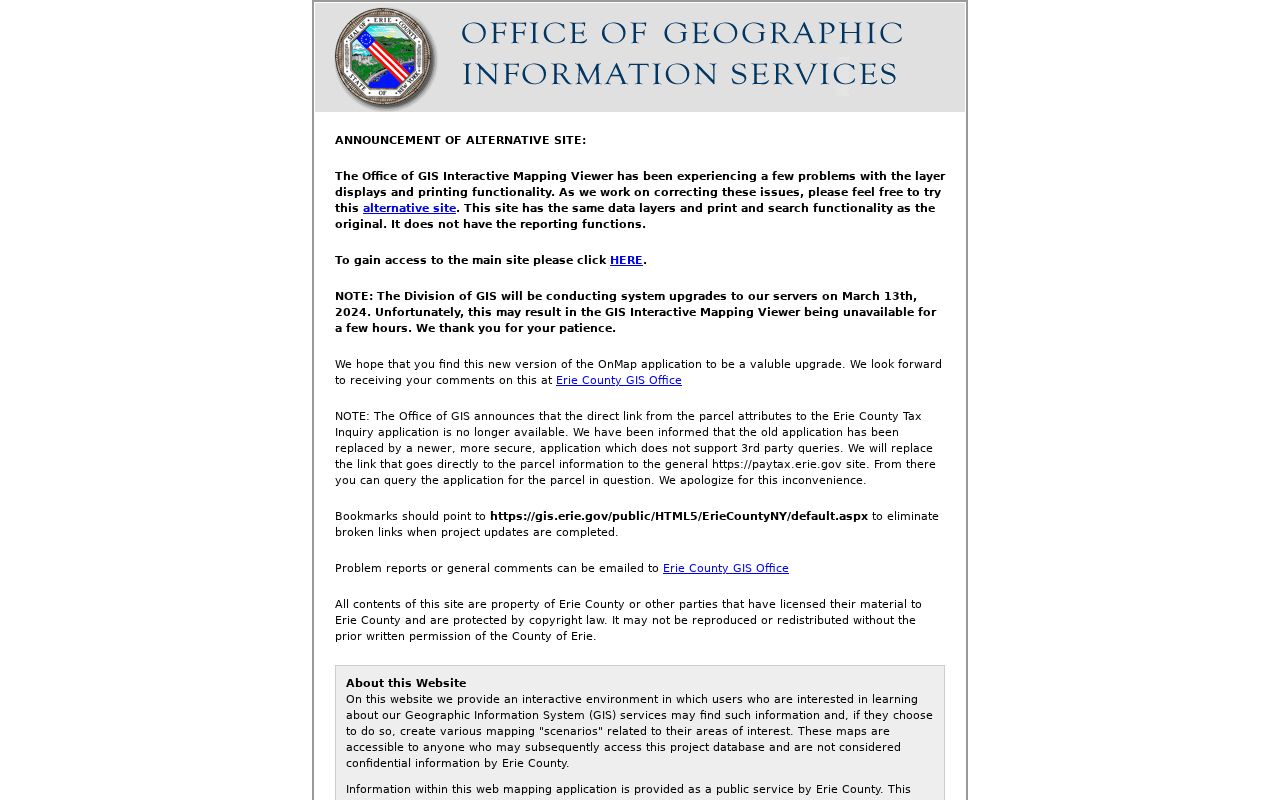
Clicking each polygon creates an address-to-parcel trail, not an automatic neighbor or resident list. Parcel lines, coordinates, and dimensions are illustrative rather than a legal survey, so boundary questions belong with the appropriate office.
Street, ZIP, school, legislative, flood, and wetland layers add useful context. They should not be used to replace the parcel, deed, or municipal record that answers the underlying ownership question.
Note: Confirm a changing map field with the custodian before treating it as a current legal or ownership fact.
Buffalo Deed Index Records
Erie County maintains deeds from 1808, yet the online land index begins in 1986 and online deed images begin in 1960. This is the key Buffalo address-record quirk: the Erie Clerk Browser View does not search official records by address. Move from the property or GIS result to a parcel/SBL, party name, instrument number, or Liber and book/page reference. A blank street search is not evidence that a deed does not exist.
The browser exposes party, document type, instrument number, book/page, map number, parcel ID, date range, and a direct-names option. Results can identify a party role, recording date, document status, and the route to document metadata or an image when available. For older images, the Graves alphabetical grantor-grantee index can help locate Liber/Book/Page. Search party spelling variants and legal names for estates, trusts, corporations, and multiple owners.
The Clerk’s Browser View shows the party, parcel, map, and book/page controls used after the address-to-parcel join.
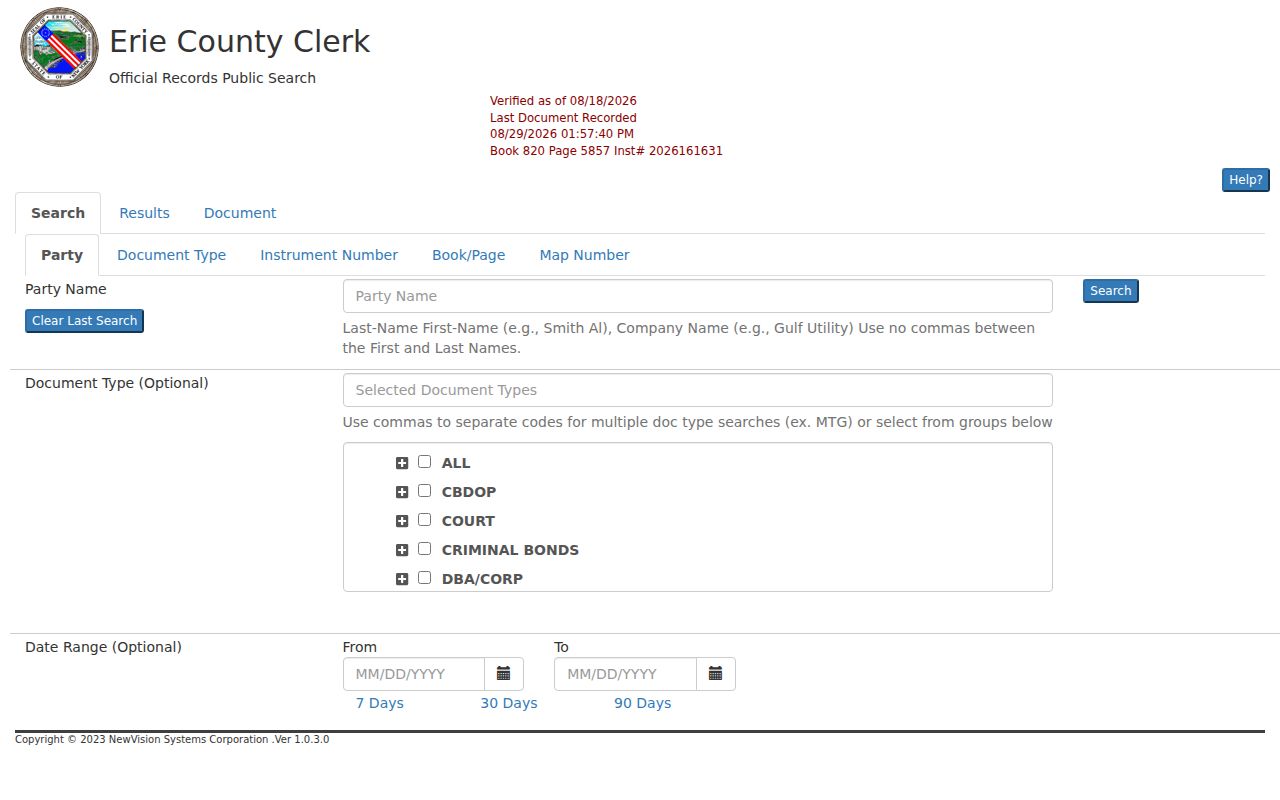
Online metadata is only one channel. Older books and indexes, public terminals in Basement Records and on the first floor, staff assistance, and a written request to the Erie County Clerk at 92 Franklin Street, Buffalo, NY 14202 remain part of the chain. A letter can identify the document type, party, property address, approximate years, book/page or file number, contact details, and return mailing information.
Buffalo Street Directory Record Coverage
Different Buffalo records answer different street questions. The property and GIS layers are strongest for the current parcel and owner fields. Deeds show a legal transfer trail. City permit and code data document address-linked activity, while historic directories supply dated listings. The voter file is a restricted FOIL channel rather than a public web roster.
| Address record | Search key | What it returns | Coverage or limit |
|---|---|---|---|
| City property card | Address or owner | Owner, situs, mailing address, transfers | Current card |
| Erie GIS | Address, owner, SBL, map click | Parcel, owner, mailing, district fields | Layer stated current to 2025 |
| Erie deed index | Party, parcel, instrument, book/page | Grantor, grantee, legal description | Index 1986; deeds maintained from 1808 |
| Buffalo permits | Address, date, ZIP, type | Permit and work context | 2007-present, recent omission |
| Code violations | Address and date | Violation and status context | 2016-present |
| City directories | Address or surname | Annual occupant or business listing | 1828-present; digitized 1832-1913 |
| Reverse directories | Address | Selected historical occupant | 1883-1915, selective coverage |
| Voter FOIL | Geography, address, name | Permitted election fields | Current file by request |
The Buffalo street directory record mix is most useful when each item is dated. A mailing address, a permit contractor, a recorded grantee, and an old directory entry should never be treated as interchangeable evidence of present residence.
Buffalo Permit and Code Records
Buffalo DigEplan provides an address-based permit lookup with a correct address, date range, ZIP, and permit type. Street names that begin with a number should be spelled out. The permit dataset begins in 2007 and omits the most recent two weeks. Buffalo’s open-data code-violation material begins in 2016. These sources can date work or a violation status, but a named contractor or contact is not proof of residence.
The official DigEplan instructions show the address, date-range, ZIP, and permit-type path.
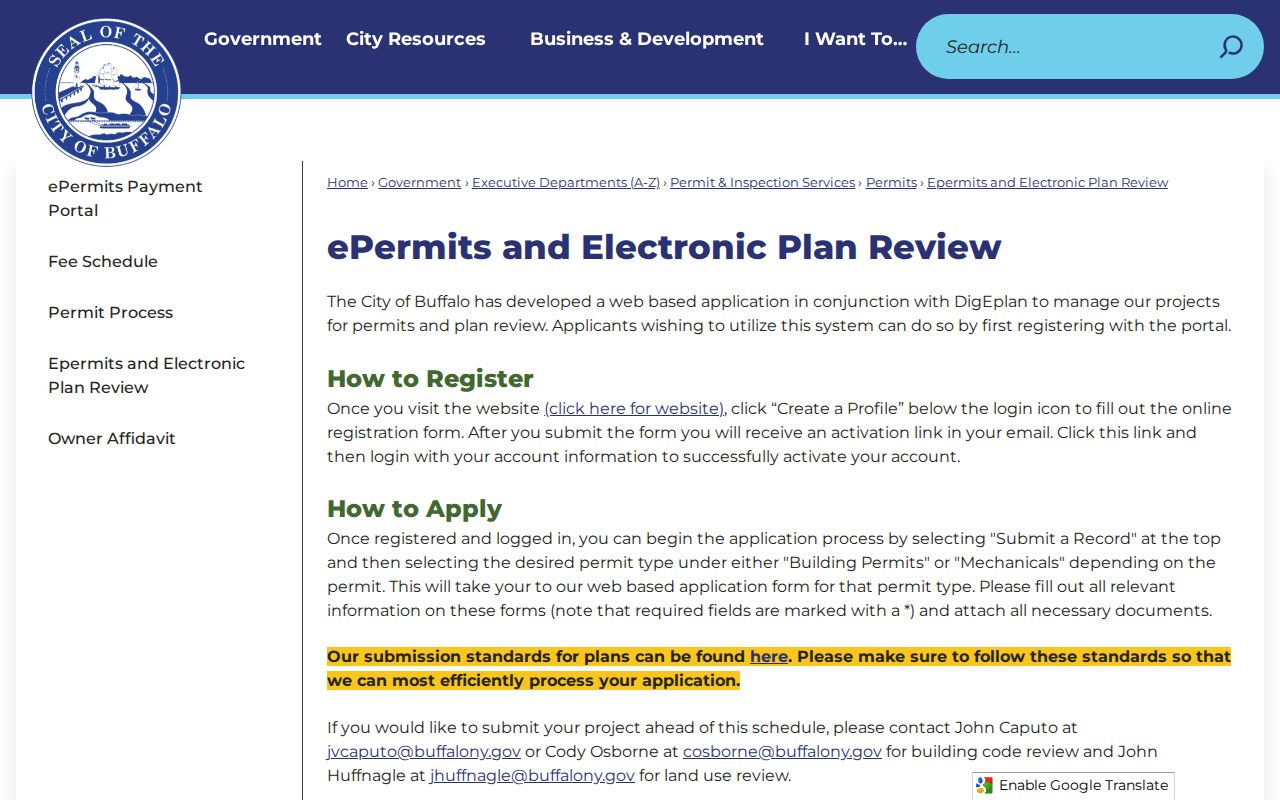
Use a permit date as a property-history marker, then confirm related ownership through the parcel and Clerk records. The omission window also means a very recent search can be incomplete.
Note: Permit and code results describe address-linked activity, not a complete record of every person connected with the parcel.
Buffalo Voter Record Limits
No unrestricted Erie County name-to-address voter lookup was located. The Erie County Board of Elections information and records route directs public-record requests through FOIL. County materials support requests by Town, Ward, or District, with party selections, requested fields, and address or name sorting. A voter registration or update form is for the voter’s own record, not a Buffalo street-directory search.
| Request element | County FOIL form choice |
|---|---|
| Geography | Town, Ward, or District |
| Fields | Address, phone, date of birth, gender, geography, voting history, or other requested field |
| Sort | Town/Ward/District, address, or name |
| Format | Paper, electronic, Excel, DBF/CSV, map, or enrollment-list option |
New York Election Law §3-103(5) requires an elections-purpose statement for voter-file access. Confidential registrants are protected under Election Law §5-508, and ballot choices are not voter-file fields. The Erie Board of Elections is at 134 West Eagle Street in Buffalo, with public information also available by phone at 716-858-8891.
Note: An absent or inactive voter record is not proof that a person did not live at a Buffalo address.
Buffalo Address Record Terms
Address research becomes clearer when the same words mean the same thing in each record family. The parcel fields join the map to the tax and deed systems, while directory terminology describes a dated listing. These terms keep a Buffalo street search from turning a correspondence address into a claim about occupancy.
- Parcel
- A mapped unit of land identified in Erie systems by a PIN or SBL and tied to property data.
- Situs address
- The physical address of the parcel or building. It can differ from the owner’s tax mailing address.
- Legal description
- The deed description of land, such as lot, block, subdivision, or metes-and-bounds language. It can bridge an address change.
- Criss-cross directory
- A reverse address directory that begins with a street and number, then lists a selected historical occupant or business.
Note: Preserve the source year and the exact address form whenever a directory entry is compared with a current parcel record.
Buffalo Street Names and Boundaries
Older Buffalo work often needs an old street name as well as the modern address. North Street was formerly Guide Board Road, a local reminder that a search may fail if it uses one form only. Try directional and suffix variants, adjacent owners, legal descriptions, assessment maps, and directory address sections when a historic address does not line up cleanly.
There is no official source in the research identifying one citywide Buffalo street-renumbering or readdressing year. Do not assign a year to an address change without a record for that particular street. Also keep ZIP delivery geography separate from municipal jurisdiction, since a Buffalo postal address can point to another Erie County municipality.
Buffalo Street Directory History
For a past household, the Grosvenor Room holds Buffalo city directories from 1828 to the present, and NY Heritage has digitized volumes from 1832 through 1913. The Buffalo History Museum holds selective Metro Buffalo reverse directories for 1883 through 1915, mostly on the West Side and for middle- and upper-income areas. That coverage makes a missing entry a collection limit, not proof of absence. The fuller historical collections and their abbreviations are described on the Buffalo city directory page.
Use the street number, the printed abbreviation key, and adjacent volumes together. A move, a name change, or a boundary difference can explain why one year does not match the next.
Buffalo Street Directory Privacy Limits
A Buffalo street directory cannot reveal every person connected to an address. Non-owner household members, unrecorded occupants, utility and delivery customers, casual DMV address data, sealed filings, and private association rosters are not a public street list. The federal DPPA protects DMV personal information. New York’s Address Confidentiality Program safeguards eligible actual addresses under Executive Law §108, and confidential voter registration can withhold an actual address under Election Law §5-508.
Even public records can be incomplete, delayed, or tied to the wrong relationship. Verify the record with its custodian and respect a protected address or sealed file.
Lawful use. Use Buffalo address records for personal, lawful research and civic or family-history questions. Do not use an address trail to monitor, threaten, contact, expose, stalk, or harass any person.