
Buffalo Resident Lookup Records
A Buffalo resident lookup has no single official name-to-address database. The useful starting point depends on the question. A property card can identify an owner and the parcel's situs, a court index can confirm that a party appeared in a case, and a vital index can establish an event or family connection. Each source has a different keeper and a different limit. In particular, a tax mailing address can help locate correspondence for an owner but does not establish who occupies the property.
| Record | What It Confirms | Where | Access |
|---|---|---|---|
| Property card | Owner, situs, tax mailing address, and parcel traits | Buffalo Assessment and Erie parcel/GIS systems | Public search; mailing address is not occupancy proof |
| Recorded deed | Conveyance parties, legal parcel history, and recording date | Erie County Clerk land records | Online index begins in 1986; images begin in 1960 |
| Court docket | Party appearance, case number, type, and date | New York e-Courts and Surrogate's Court | Some files and details are restricted |
| Vital index | Birth, death, marriage, or family-event trail | Buffalo City Clerk or NYS Department of Health | Genealogy windows differ from current-copy rules |
| Voter file | Requested registration fields and election geography | Erie Board of Elections records | FOIL route with elections-purpose limit, not an open lookup |
| Probate or license record | Estate context or published credential details | Surrogate's Court or NY DOS Licensee Search | Access and fields vary by record |
Start with the strongest known fact. For a property question, use the parcel system first. For an estate question, use the Surrogate name and date route. For a past event, use the City Clerk or state genealogy rules. That choice keeps unrelated names from being merged into one resident search.
Buffalo Resident Lookup Names
Normalize the name before searching. Try a middle initial, a maiden or married name, a suffix, a diacritic-free spelling, and common abbreviations. Buffalo's historical sources reflect Polish, German, Irish, Italian, Black migration, Eastern European, and other naming traditions, so a single spelling can miss a relevant record. Pair each version with an exact street, a parcel or SBL, a spouse or parent, a business, a date, or a school year.
Then read the role beside the name. A grantor is transferring property and a grantee receives it. A plaintiff or defendant is a court role. An owner and a mail recipient can be different people. An obituary survivor may be a family connection, not the person whose address is being researched. Dates make those distinctions usable.
When a Buffalo name is tied to a regulated credential, the NY DOS Licensee Name Search accepts last name, first name, license type, county, city, and ZIP. Published status depends on the license type. A license or business result can support a separate fact, but it does not establish a person's present address or household connection.
Note: A result that lacks a matching date, place, or relationship is a lead to verify, not an identity conclusion.
Buffalo Court Lookup Routes
New York e-Courts separates Buffalo City Court, Erie County Court, Supreme Court, Family Court, and related systems. WebCivil Local and WebCivil Supreme cover civil routes where available, WebCriminal covers current cases for Erie County Court and Buffalo City Court, and WebFamily has a limited public index. Federal civil and criminal matters use the Western District case-information route and public courthouse access. For estates and wills, Surrogate's Court Web Search is the better route. It offers Name Search, File Search, Old Index Search, Index Book Pages, and Will Search.
| Field or control | How it narrows a court search |
|---|---|
| Name | Party name in WebCriminal and Surrogate Name Search; use documented variants. |
| Case or file number | Direct route when an identifier is known. |
| Court or case system | Select WebCivil Local, WebCivil Supreme, WebCriminal, WebFamily, eTrack, or NYSCEF. |
| Date of death | Optional Surrogate Name Search narrowing. |
| File name or testator | Used in Old Index and Will Search modes. |
| Index book and page | Paired fields for the Surrogate index route. |
A Surrogate result can show the party or testator name, file number, date of death, old-index file name, book and page, county context, result link, and an image link where available. After February 19, 2014, some image links are online. Older files may require the Erie public computers in Room 201 at 92 Franklin Street, a clerk request, or a copy request.
- Party or testator: the person named in the estate or case result.
- File number and date of death: identifiers that narrow an estate request.
- Old-index file name and book or page: historical finding details when the newer route is incomplete.
- County context and image link: the court location and any online document path available for that result.
Family, juvenile, adoption, sealed, and expunged details are not general directory material. Confidential personal information restrictions also apply. A docket is an index of case activity, not a complete account of a person's history.
Buffalo Vital Record Paths
For Buffalo events, the City Clerk genealogy route is separate from NYS Department of Health procedures. Genealogical birth records generally open after 75 years when the subject is known deceased. Death records generally open after 50 years. Marriage records generally open after 50 years when both parties are known deceased. Current certified copies have relationship, identification, authorization, or court-order limits under New York's vital-record rules.
The local written genealogy request asks for the full name, event date and place, record type, requester contact information, and a self-addressed envelope. The standard local fee is $22 for a three-year index search and a copy or no-record response. Send the money order payable to City Clerk to Vital Records, Room 1302, City Hall, 65 Niagara Square, Buffalo, NY 14202.
The Buffalo genealogy instructions show the local thresholds and written-request path for historical event research.
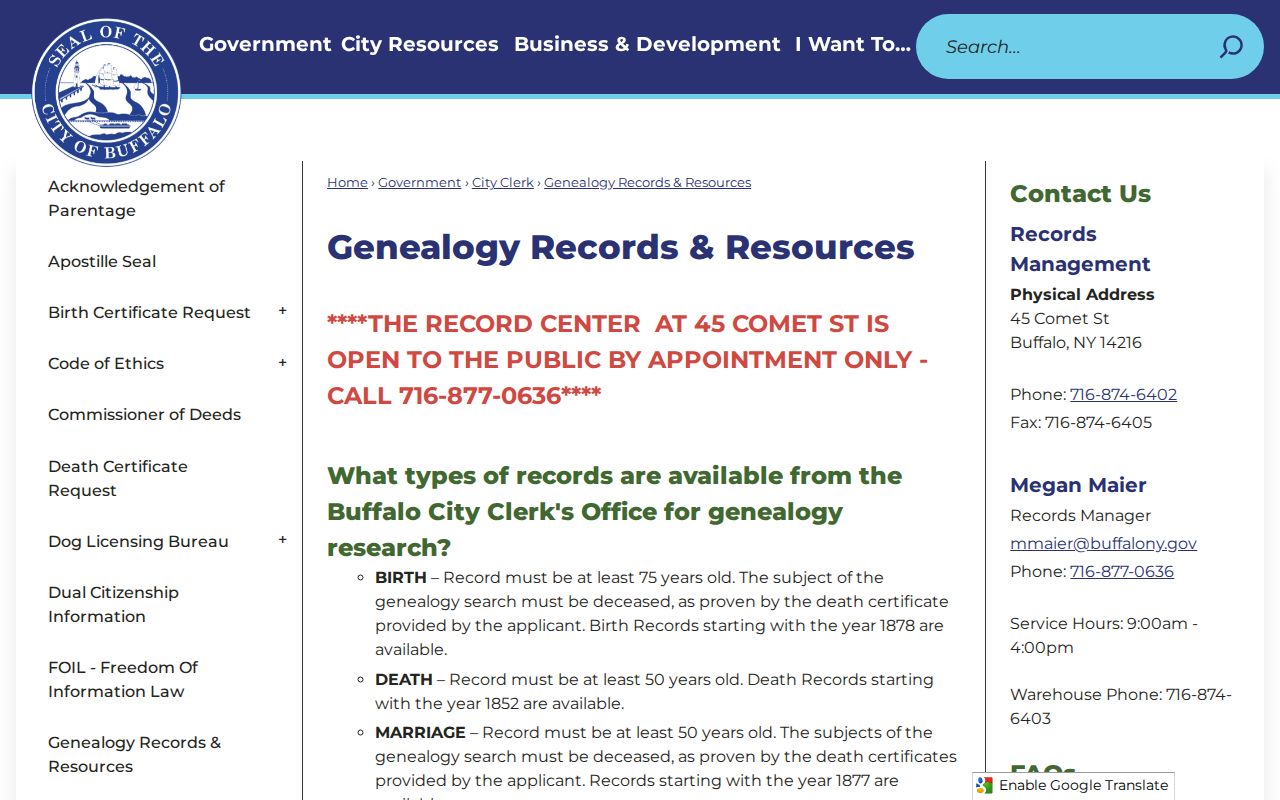
Use the screen as a reminder to check the current custodian's eligibility wording before sending a request, because local and state procedures can differ.
Buffalo Resident Lookup Trails
Estate and school-history questions need more focused records than a broad name search. For an heir trail, identify the decedent through an obituary or vital index, run a Surrogate Name Search with a party name and narrow date-of-death range, record the file number, and ask for older or restricted material at 92 Franklin Street. Probate can identify an estate file and fiduciary or heir context, but it is not an unrestricted resident directory.
For a former classmate, Buffalo and Erie yearbooks, school or community newspapers, city directories, and obituary evidence are separate checks. Use the school, class year, full name, photograph, and activity when available. The Buffalo and Erie County Public Library's Grosvenor Room holds yearbooks from the 1880s to the present along with directories and newspapers. The annual-volume trail is also useful on the Buffalo city directory page. These sources are historical snapshots, so a later official record is still needed for a current claim.
Birth-parent information follows the NYS DOH regulated adult-adoptee pre-adoption certificate process. It is not a public name search. The research describes a $45 route and a paper-only descendant route, with sealed-adoption exceptions and eligibility rules that must be checked directly with the state.
Verify a Buffalo Resident
Use two independent record families before treating a match as reliable. A property record and a deed can confirm a parcel relationship. A court or probate index can add a date and legal role. A vital index can support an event or family link. The sequence below avoids turning a same-name hit into an unsupported conclusion.
- Write the full name and all reasonable variants, then choose one strong identifier such as an exact street, parcel/SBL, spouse, parent, business, or school year.
- Search the Buffalo property card or Erie parcel record for the address and keep situs and mailing fields separate.
- Use the party name, case number, or Surrogate file tools to check a court or estate index, matching dates and roles.
- Check a vital or historical source only for the event it can support, then request a certified copy from the custodian if an official certified document is needed.
- Report a data issue to Buffalo Assessment, the Erie Clerk, Board of Elections, court clerk, DOH, or DOS, rather than relying on a copied result.
- Docket
- A court's case list, showing matters such as parties, filings, and dates. It is not the full file.
- Index versus image
- An index gives finding details, such as a name or file number. An image is the scanned record itself and may be unavailable or restricted.
- Certified copy
- A copy issued and certified by the custodian for an official purpose. Eligibility and fees depend on the record type.
Buffalo Local Vital Searches
Buffalo and state requests answer related but different questions. The Buffalo City Clerk holds Buffalo event material, including local genealogical routes and historic indexes. The NYS Department of Health vital-record service handles events outside New York City and statewide divorce certificates. The DOH form asks for subject information, event details, relationship or deceased evidence, search years, and payment. It is not an ordinary FOIL request.
Both the local genealogy route and the state long-search route list a standard $22 search fee, but the state research notes warn that a long search may take eight months or more. A Buffalo event that meets the City Clerk's genealogy conditions can therefore be a practical local first route. A divorce certificate and the underlying court file are separate records with separate access rules.
Note: A no-record response is not proof that an event never occurred, because the date, jurisdiction, and index window may be wrong.
Buffalo Voter Record Limits
Erie County did not provide an unrestricted public name-and-address voter lookup in the official sources reviewed. New York's online registration and update route serves a voter who is registering or changing information. It is not an open person-search tool. Voter-file access instead uses the Erie Board of Elections records and FOIL channels, and a state request requires an elections-purpose statement under Election Law §3-103(5).
The county form can request a geographic area by town, ward, or district and select delivery formats, parties, requested fields, and sorting. It is not a ZIP-wide lookup. Confidential registration under Election Law §5-508 permits protected registration for eligible domestic-violence victims, with the actual address withheld from ordinary public records. A missing voter result also does not prove that someone did not live in Buffalo.
The Erie Board of Elections information and records page is the official entry point for the voter-record and FOIL process.
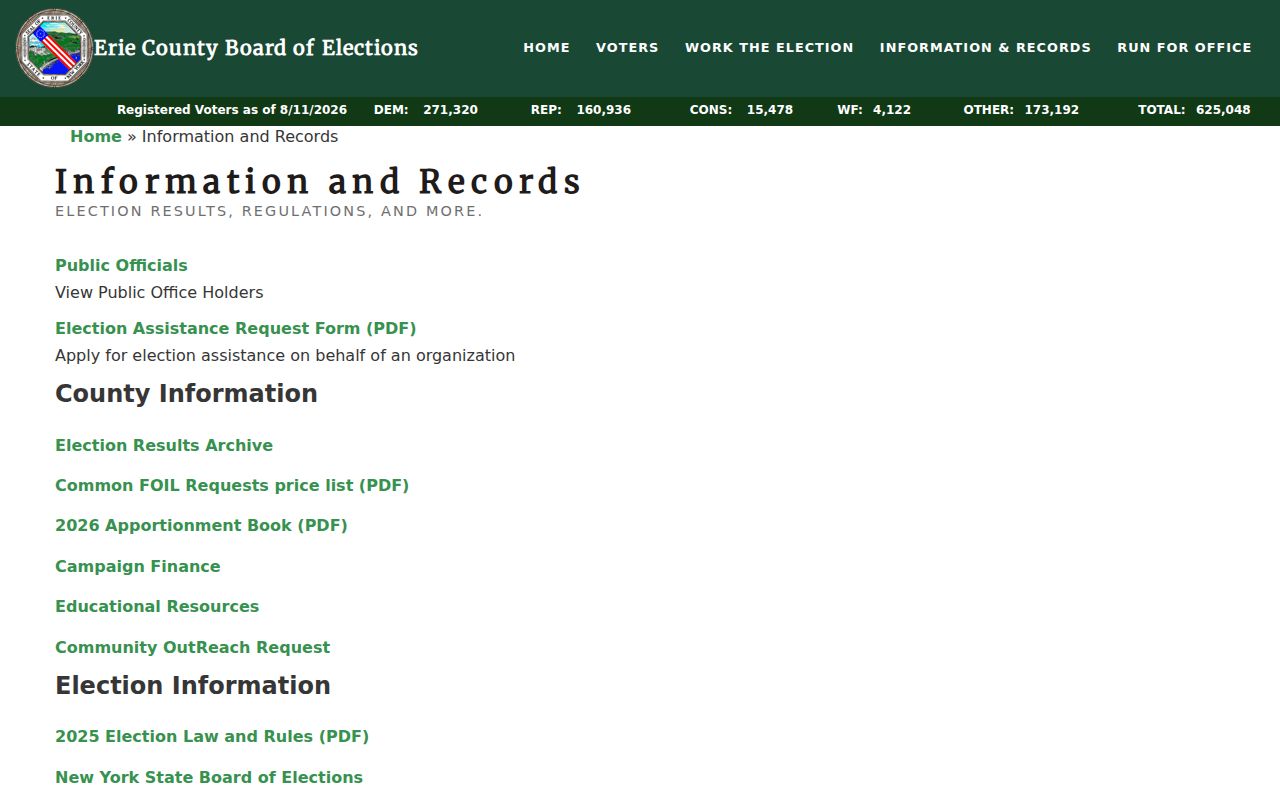
Use the form's stated geography and purpose fields as limits on the request, rather than treating an election record as an open resident list.
The New York registration and update route is shown because it is often confused with a person-search tool.
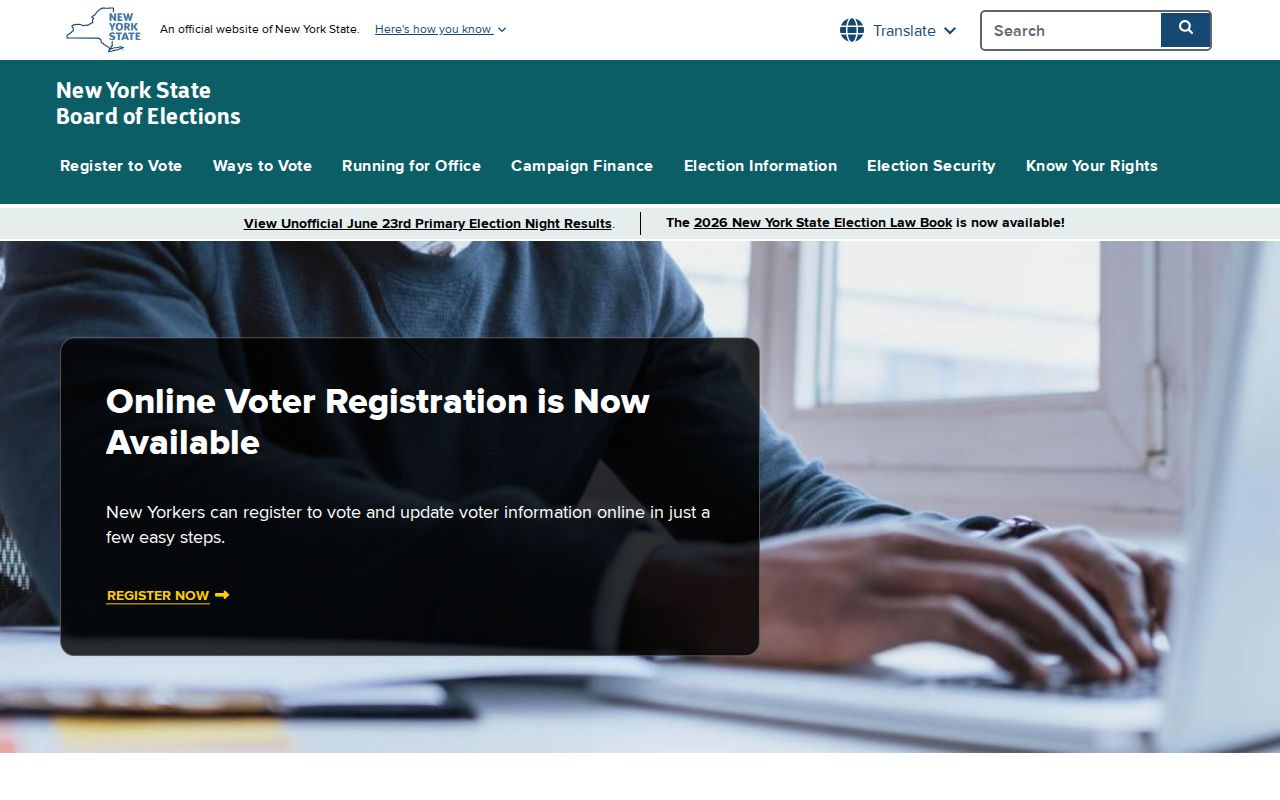
Registration or an update changes a voter's own record. It does not provide a public address search for Buffalo residents.
Buffalo Lookup Fallbacks
When an online result stops short, use the channel that holds the record. Older Surrogate material can be viewed through courthouse computers or requested from the clerk. Older deeds may require the Clerk's public terminal, books, microfilm, or a written request. Grosvenor Room staff can perform limited directory or obituary lookups, while Records Management provides appointment access to historic city material. A records request under the New York Freedom of Information Law, Public Officers Law Article 6, §§84-90, may be appropriate for an agency record that is otherwise available under that law, but vital records follow their own application route.
New York DOCCS is a separate official route for current incarceration information. It accepts a DIN or a name and date of birth, but it is a status database rather than proof of present Buffalo residence.
The New York DOCCS Incarcerated Lookup shows the official name, date-of-birth, and DIN search path.
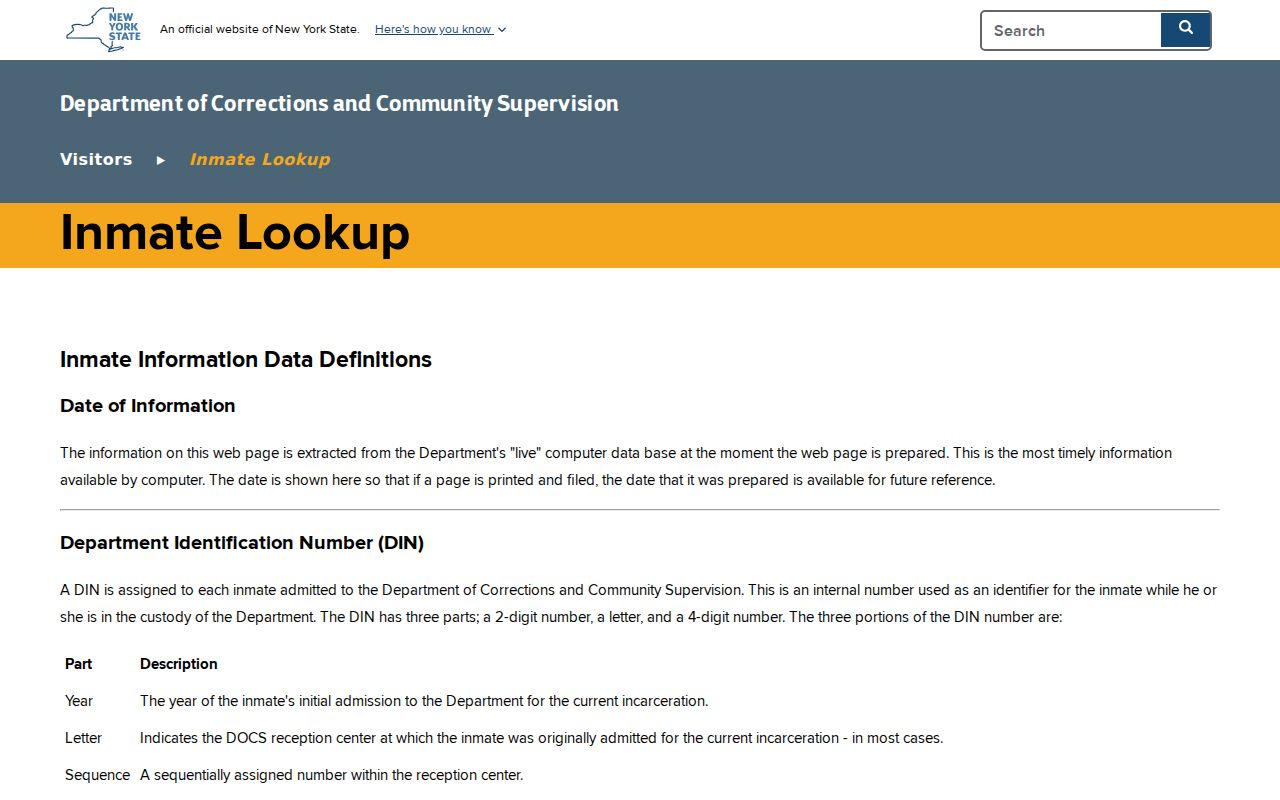
A jail, DOCCS, or registry result is a time-specific record. Do not treat it as a complete history or republish a protected address.
Buffalo Resident Lookup Privacy
Some gaps are deliberate. The New York Address Confidentiality Program under Executive Law §108 protects eligible actual addresses through a substitute-address process. Protected voter registration, sealed court material, adoption material, confidential personal information, and federal driver-data rules also limit what a search can disclose. When a record has an error, use the custodian's correction or redaction route. Do not publish sensitive numbers or assume an older recorded document has been fully redacted.
Lawful use. Use these records only for personal, lawful research. New York Penal Law §§120.45 and 240.30 address stalking and aggravated harassment, and protected people must not be monitored, threatened, contacted, or exposed.