
Buffalo Previous Residents by Era
Different Buffalo records cover different parts of an address history. Deeds identify parties to a legal transfer, tax books follow a property and its assessed owner, directories record an annual listing, and census schedules add household detail at a decennial date. Start with the newest source that fits the question, then move backward only after recording the parcel identifier, deed reference, exact address form, and dates already found.
| Source | Years It Covers | Where Held | What It Shows |
|---|---|---|---|
| Erie deed books | 1808-present maintained | Erie County Clerk and deed books | Legal conveyance and named parties |
| Erie online deed index | 1986-present | Erie County Clerk Browser View | Party, instrument, date, and index information |
| Erie deed images | 1960-present | Clerk portal, account, counter | Image and legal text |
| City tax and assessment books | 1815-1837 bound; 1838-1997 microfilm | Buffalo Records Center | Tax, assessment, owner, and property trail |
| Buffalo City Directories | 1828-present; 1832-1913 digitized | Grosvenor Room, NY Heritage, Records Center | Annual occupants, businesses, and addresses |
| Reverse directories | 1883-1915, selective | Buffalo History Museum | Selected address-to-occupant entries |
| Federal census | Public through 1950 | Library databases and collections | Household, age, relationship, and birthplace |
| Buffalo permits | 2007-present, latest two weeks omitted | Buffalo DPIS | Structural activity and date context |
Records do not use the word resident in the same way. A deed party may be an owner, an estate, a trust, or a corporation. A directory entry may be a household head, business, boarder, or widow. A tax mailing address can differ from the situs, the physical parcel address. Keep the source role next to every name before deciding who lived here before.
Start Buffalo Address Records With a Parcel
The backward trail starts with a current property record, not an ordinary street search at the Clerk. Use Buffalo assessment information or the Erie parcel and GIS tools to capture the situs, owner, mailing address, SBL or PIN, deed date, lot dimensions, property class, and transfer history. The property card may also include tax detail, exemptions, building characteristics, improvements, nearby sales, and aerial imagery. Those fields help distinguish similarly numbered streets or later subdivision changes.
Use Erie County Property Alert as a source for the parcel-oriented search path, including Property Location and By Owner modes followed by Details.
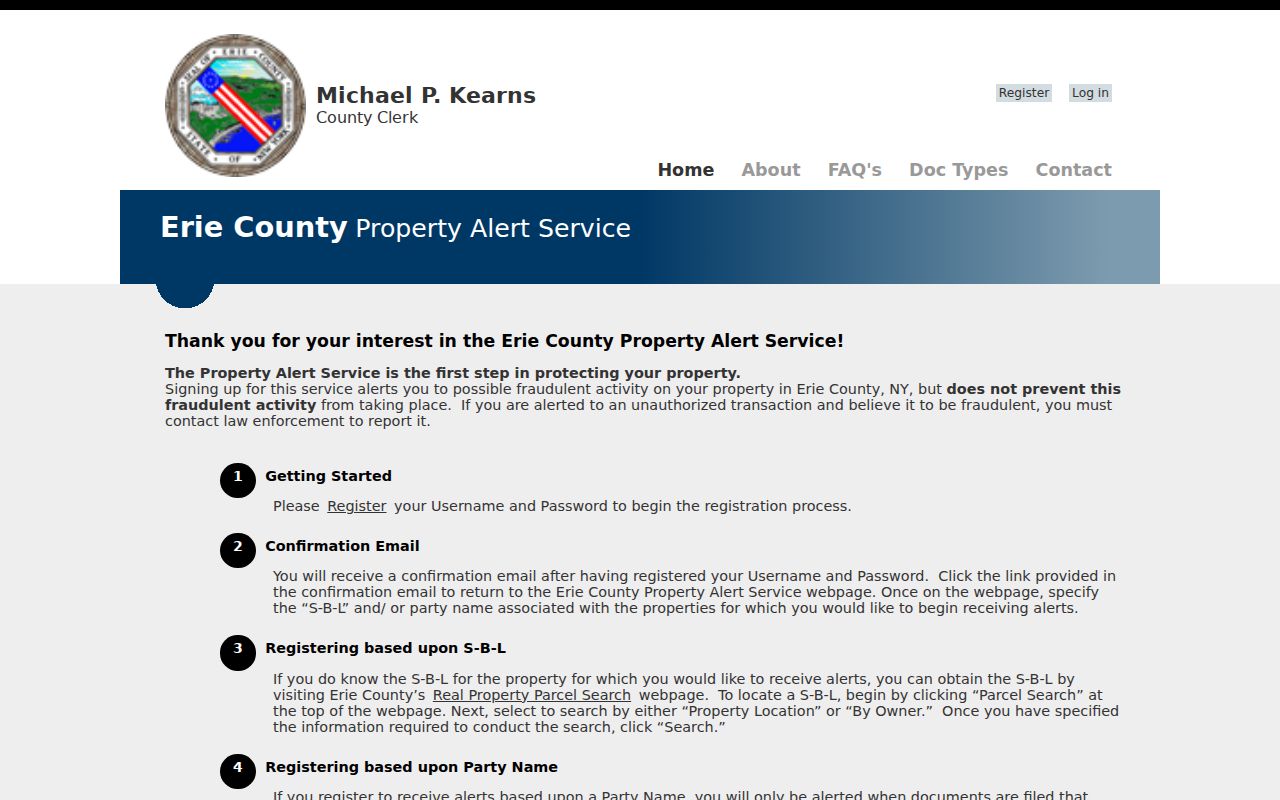
Details can provide the SBL and a deed book, page, or file reference. Record both the parcel's physical situs and the tax mailing address, but do not treat the mailing address as proof that the owner lived there. The parcel and recorded identifier are the durable join between city property records and the County Clerk's deed material.
Buffalo Address Records Need a Deed Join
Erie County Clerk official records are not searchable by ordinary property address. A blank street query is therefore not proof that no deed exists. First obtain the parcel, SBL, deed book and page, file number, or current owner from the city or county property record. Then search the Clerk by party, instrument number, book and page, map number, parcel ID, document type, or date range. The Browser View also offers a direct-names option to narrow party results.
The Erie County Clerk Browser View shows the party, parcel, map, book-page, instrument, and date search controls used for this second step.
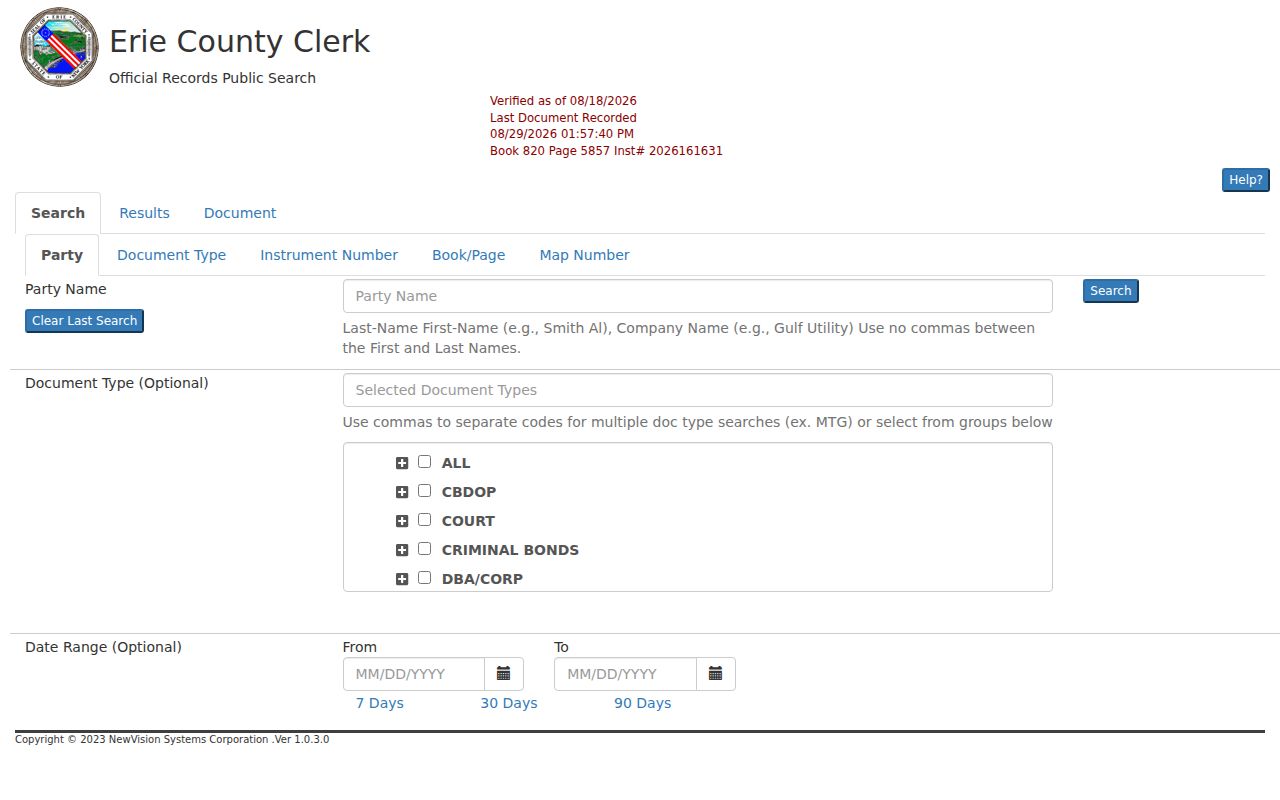
The result metadata may be public while full image access depends on the record category, account, browser route, subscription, or counter access. Try spelling variants and read a party's role carefully. The current owner's deed is only the starting point, because the seller on that deed may point to the prior ownership record.
Note: An Erie deed search begins with the parcel or party identifier because the official-record index does not provide ordinary street-address searching.
Buffalo Deed Records Before 1986
The key numerical boundary is easy to misread. Erie deeds are maintained from 1808, the online deed index begins in 1986, and deed images reach back to 1960. Earlier research is still possible, but it shifts from a web index to the Graves alphabetical grantor-grantee indexes, microfilm, deed books, public terminals, or a written Deed/Search and Copy request. A date outside the online index is a change of channel, not the end of the title trail.
Public terminals are available in Basement Records and on the first floor, where Clerk staff can assist with material that is not online. A letter can identify the document type, party or owner, property address, approximate recording years, book and page or file number, contact information, and return mailing information. The Clerk's deed request form supports mail or in-person requests at 92 Franklin Street, Buffalo, New York 14202, Monday through Friday from 9:00 to 4:30. It states $5 in person and $10 by mail, including a $5 search, with check or money order.
For copy requests outside that form, the published schedule gives $1.30 for the first two pages and $0.65 for each additional page. Certified copies are $5 for the first four pages and $1.25 for each additional page, with a noted maximum of $40. Manual search is $10 per name per two-year period, while digital search is $5 per name per two-year period.
Trace Buffalo Prior Owners Through Erie Deeds
A deed chain, also called a chain of title, follows each transfer backward from the latest known owner. Start with the current parcel and make a separate entry for every party, role, recording date, legal description, parcel reference, and related document. Trusts, estates, corporations, and multiple owners need their own name and role checks. The legal description, not a loose street name, bridges an address change because a lot, block, subdivision, or metes-and-bounds description may persist after a street is renamed or renumbered.
- Capture the current Buffalo parcel, its situs, owner, mailing address, SBL or PIN, deed date, and transfer history.
- Use the property details to obtain a deed book and page, file number, or instrument number.
- Search the latest deed and transcribe the grantor, grantee, recording date, legal description, parcel references, and any transfer text visible.
- Treat the seller or grantor as the prior owner, then locate that party's earlier purchase as a grantee. Repeat for each conveyance.
- At the online boundary, switch to Graves indexes, microfilm, public terminals, deed books, or the written request channel.
- Use the legal description, lot or block, subdivision, and adjoining parcels to carry the search across an address change.
- Grantor and grantee
- The grantor transfers an interest in property. The grantee receives that interest in the recorded instrument.
- Chain of title
- The sequence of recorded transfers used to trace property ownership through time.
- Legal description
- The deed's lot, block, subdivision, or metes-and-bounds description. It is more stable than a street address for older records.
Buffalo Household Records in Directories
Ownership is only one part of who lived at an address. Buffalo city directories can provide annual occupant or business listings, while a federal census supplies household composition at a decennial date. The library holds city directories from 1828 to the present, and NY Heritage digitizes original volumes from 1832 through 1913. Reverse directories at the History Museum run from 1883 to 1915 but are mostly West Side and middle- or upper-income, so their omissions are meaningful limits.
NY Heritage's digitized Buffalo City Directories offers the online portion of the annual address trail.
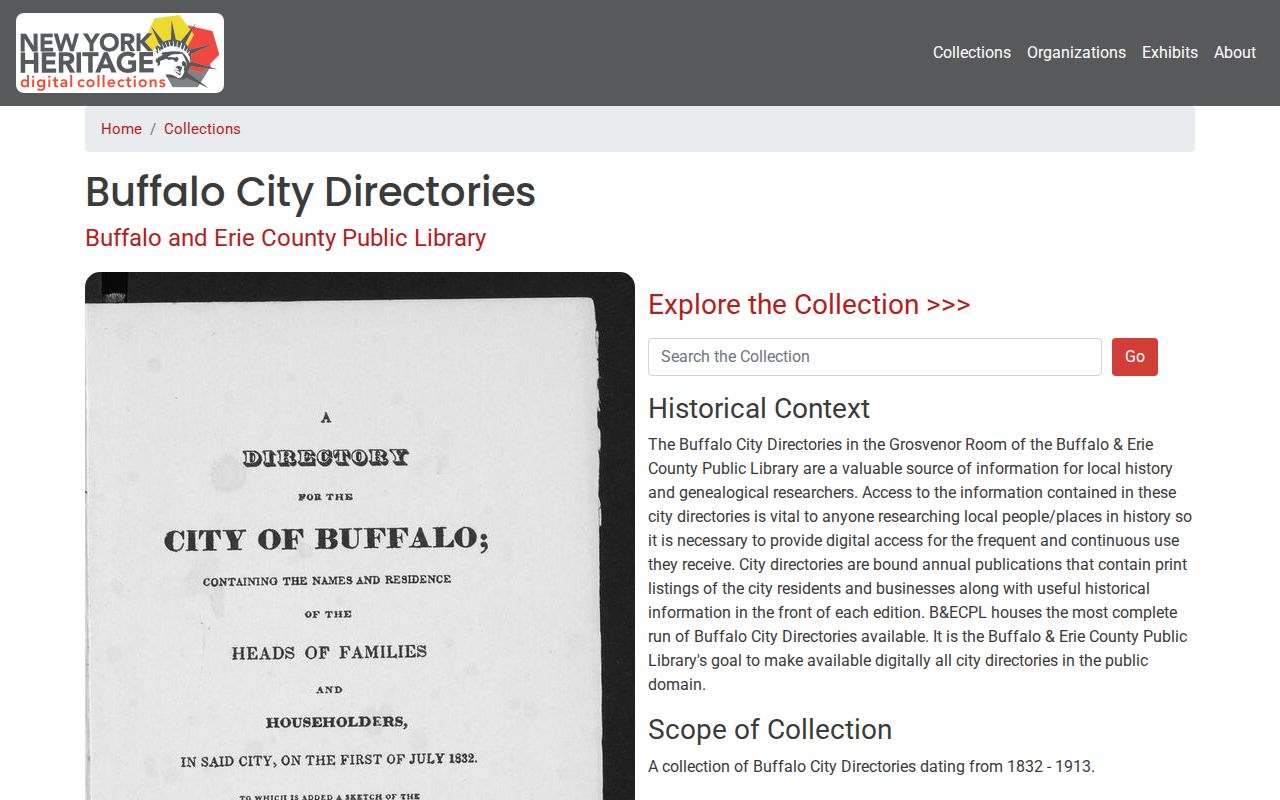
The image collection can establish a year, name spelling, address, and business reference before a researcher consults later volumes in person. The historical collections themselves, including how to read [h], [r], spouse, widow, and address-section marks, are collected in the Buffalo City Directory resource.
- Locate the exact address in an address section, then check the alphabetical entry for the same year.
- Copy the name, occupation or business, spouse or widow notation, address, and any owner or resident mark.
- Move year by year and search surname, business, and variant spellings when an entry changes or disappears.
- Pair a directory decade with the federal census to compare annual address continuity with household relationships.
- Use a newspaper, obituary, cemetery record, probate file, or later directory to explain a move, death, or disappearance.
Buffalo Address Records and Old Names
Do not assign a citywide renumbering year to a Buffalo address history. The official sources reviewed did not identify one. Instead, preserve a bridge record of old and new street names, directional and suffix variants, legal description, lot map, and adjacent owners. Buffalo's preservation material notes that North Street was formerly Guide Board Road, a concrete reminder that an old name can block an otherwise careful search.
Historic maps make the bridge stronger. The Records Center holds assessor land maps for 1855, 1870, and 1912 on microfilm. It also holds tax and assessment books from 1815 through 1997 in bound and microfilm formats. Sanborn maps cover Buffalo from 1889 through 1951 and can add structure footprint or use, but they do not prove an occupant's identity.
Forest Lawn began in 1849. Cemetery records, church registers, and newspapers can therefore help distinguish a household departure from a sale or address change when a person stops appearing in a directory.
Buffalo House History Records
House history works best when the sources are kept in order: address section, directory abbreviation, Sanborn footprint, assessment map, deed legal description, permit date, newspaper item, obituary, and History Museum material. The Buffalo Library's Buildings and Architecture guide is the local reference route for combining those layers. A permit or code record provides work and date context, not proof that the named party lived at the address.
Buffalo's permit dataset begins January 2, 2007 and omits the latest two weeks. Code-violation data begins March 28, 2016. Those date limits make permits useful for identifying structural change in the modern period, while the tax books, maps, deeds, directories, and newspapers carry an older address trail.
Note: A complete address history may contain gaps because each Buffalo source records a different relationship, date range, and level of access.