
Finding Buffalo Residents Carefully
No single public roster lists everyone in Buffalo. That is the first thing to accept. A property card names an owner, an annual city directory names a household head, and an Erie County deed names the parties to a conveyance without saying who occupies the house today. The Erie Board of Elections publishes records and FOIL channels, though it offers no unrestricted public name-to-address voter search. Begin with whatever fact you already hold: a street address, a full name, a rough year, or a family link. Then pick the record family suited to that question.
For current property work, keep two addresses straight. The parcel's situs is its physical spot, while the tax mailing address can sit somewhere else entirely. For an older household, read the directory's address section, then check adjoining years, census records, obituaries, and probate. A court index confirms a public appearance, nothing more. Buffalo resident searches hold up when dates, roles, and addresses agree across two sources.
- Begin with the Buffalo assessment card or Erie parcel system when you have an address or owner name.
- Save the parcel's SBL or PIN, its situs, and its deed reference before moving to the County Clerk index.
- Use the Clerk's party, parcel, instrument, or book-and-page options for a recorded-document trail.
- For a past household, compare Buffalo city directory years with census, newspaper, and vital-index evidence.
- When a digital index stops, use the counter, public terminal, library, mail request, FOIL route, or state archive named by the custodian.
Note: Match the record type to the question first, since a public record proves only the narrow fact it was made to capture.
Buffalo Resident Records Desks
The Buffalo residents directory trail runs through several custodians. The City assessment system and county parcel tools supply property context. The Erie County Clerk keeps recorded land documents. Older county record groups sit with that office too. The City Clerk serves as local registrar for Buffalo events. New York City keeps its own vital records. Outside the city, the New York State Department of Health is the statewide route. The Board of Elections manages election records under its own access rules. Libraries and historical repositories preserve the shelves that make older Buffalo searches possible at all.
Erie County Clerk
92 Franklin Street
Buffalo, NY 14202
Records counter and public terminals
Buffalo Assessment and Taxation
City of Buffalo property records
Buffalo, NY
Assessment/address guidance: 716-851-5771
Erie County Board of Elections
134 West Eagle Street
Buffalo, NY 14202
716-858-8891
The detailed address-to-parcel path follows the Buffalo street-directory method. Custody is the useful distinction here. One office confirms one kind of fact, and a different office holds the next link.
Buffalo Property Card Clues
A property record card from the City of Buffalo is a practical opening record. It works when you hold an address or an owner name. Its labeled sections can show key information. They also cover land and site size, residential building details, improvements, exemptions, sale and transfer history, tax detail, and an aerial link. A result also separates the physical parcel address from a mailing or tax address. That distinction matters. Owners can be trusts, estates, businesses, or people who live elsewhere.
| Property-card field | How it helps a Buffalo search | Important limit |
|---|---|---|
| Street address or owner | Finds the current property record | Spelling variants may be needed |
| Situs and mailing address | Separates parcel location from owner correspondence | Mailing address does not establish occupancy |
| Sale transfer history | Supplies a bridge to the deed trail | Check the Clerk record for document detail |
| Tax detail and aerial links | Add parcel context | They are not a household list |
The City's property-card orientation explains the labeled sections before any Clerk search. Treat the card as an owner-and-parcel record, not a census of everyone at a Buffalo address.
Buffalo Parcels Lead to Deeds
Erie County's official-records index does not support an ordinary street-address search, and that single detail shapes the workflow. Get the parcel, SBL, current owner, and deed book and page or file number first. Pull these from the City property card, Erie PayTax, or the GIS viewer. Then turn to the Erie Clerk Browser View. It searches by party, document type, instrument number, book and page, map number, parcel ID, or date range. A parcel is the unit of land in the tax and mapping system. A deed is the recorded document naming a grantor and a grantee. The grantor conveys an interest. The grantee receives it.
Erie deeds go back to 1808. The online index starts January 1, 1986, and images begin January 1, 1960. Older work may call for the alphabetical grantor-grantee index, Liber or book and page, and microfilm. It may also call for physical books, a public terminal, or a request to the Clerk. Search metadata can be public even where image access depends on the account or counter route available. Try spelling variants, especially for estates, trusts, and corporations.
The Erie Clerk Browser View presents its search modes together on one screen. These include party, parcel, map, instrument, and book-page modes. Those modes show why the parcel identifier matters. It is the handoff that turns an address search into a deed search.
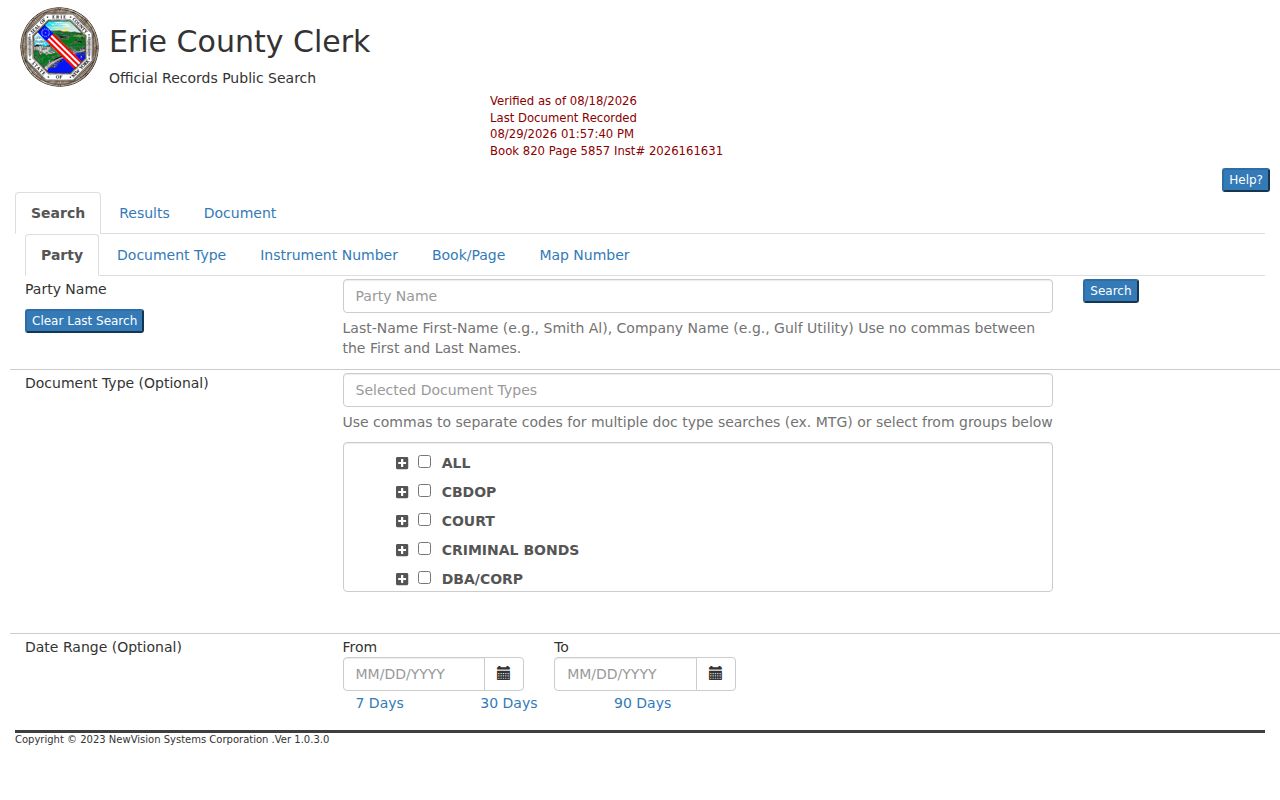
Use the document role and recording date to build a dated ownership trail, then confirm any older gap through the Clerk's offline channels.
- Parcel or SBL
- A tax and mapping identifier used to join a property to county records.
- Index
- A finding tool that points to a record, not necessarily the full record image.
- Criss-cross directory
- An address-first directory that can identify selected historical occupants.
- Recorded party
- A person or entity named in a filed document, whose role is not automatically current residence.
Buffalo Voter Records Have Limits
Election files will not serve as a Buffalo residents directory. The county elections page covers registration, apportionment, and FOIL requests. Under Election Law §3-103(5), a voter-file request needs a stated elections purpose. The county form allows sorting by address or name. It also allows selection of geography, party, and chosen fields. Protected registrations stay withheld. New York's online registration route lets a voter register or update a record. It offers no resident-search function for the public.
Two programs create deliberate gaps in the rolls. Confidential registration under Election Law §5-508 and the Address Confidentiality Program under Executive Law §108 both shield participants. A missing name can also reflect list maintenance. It can reflect a different jurisdiction, or a record type that simply does not fit. For current personal research, a property, court, business, license, or historical record usually answers the question better. An election file rarely will.
Current Buffalo Resident Sources
Each current source describes a different relationship. Property rolls are strongest for the owner-parcel link. Deed records show the parties to a transfer plus other filings. Court indexes can place a name in a public case. Privacy restrictions run strong there, though. Business and professional-license records can confirm a filing or credential. They say nothing about where someone actually lives. A vital index points to an event. A current certified copy carries its own eligibility rules.
| Buffalo source | What it can show | Custodian | Access path |
|---|---|---|---|
| Property card and parcel record | Owner, situs, mailing address, parcel details | City and Erie County | Public search |
| Recorded-document index | Grantor, grantee, document date, legal parcel clues | Erie County Clerk | Index, terminal, counter, or request |
| Election record | Requested registration fields where law permits | Erie Board of Elections | FOIL with election-purpose limits |
| Court or probate index | Public case or estate metadata | New York courts | e-Courts, clerk, or public terminal |
| Business and license search | Public filing or credential data | New York Department of State | Official state search |
Verifying one person takes a different sequence of cross-checks. The Buffalo resident lookup page keeps that name-first workflow apart from the property and historical routes.
Buffalo Genealogy Time Windows
Buffalo's vital records have precise start dates. Births begin in 1878, marriages in 1877, and deaths in 1852. New York generally opens births after 75 years. The subject must be known deceased. Deaths open after 50 years. Marriages open after 50 years when both parties are deceased. Current certified copies follow a separate eligibility process. The City Clerk serves as local registrar for Buffalo events. The State Department of Health covers events outside New York City.
A genealogy request needs the name, date and place, and record type. It also needs requester information and a self-addressed envelope. Locally, a $22 request covers a three-year search plus a copy or a no-record response. The state also charges $22 for a three-year genealogy search. It warns that processing can run eight months or more. For pre-1914 Buffalo births and marriages, try the City Clerk, Erie, library, or historical-index paths. Do not assume the statewide series applies. The Buffalo genealogy-records route spells out the local windows, request details, and mailing path.
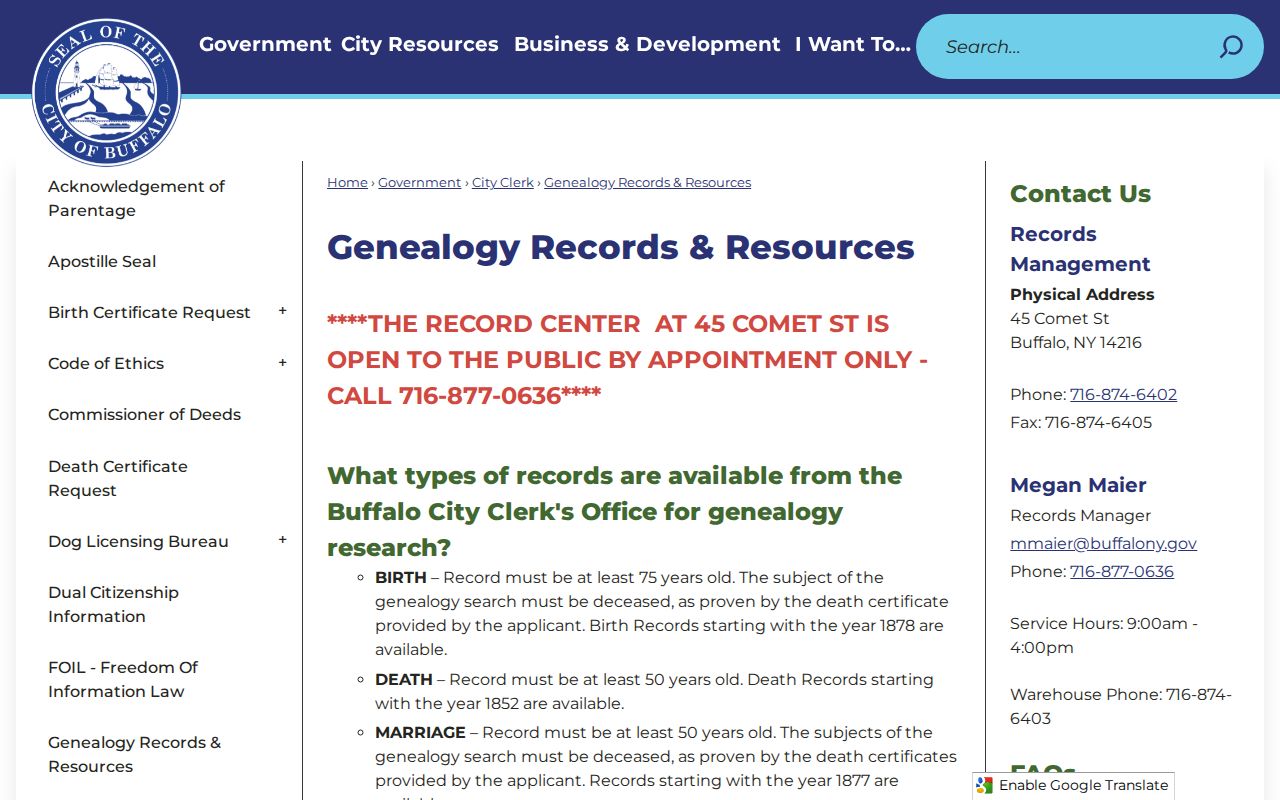
For earlier families, pair an index result with directory, church, cemetery, newspaper, or county evidence first. Confirm before you request the record. Note: Vital access is not an ordinary FOIL request, so follow the current registrar application and its eligibility instructions.
Buffalo ZIPs Need a Jurisdiction Check
A Buffalo postal label is not always a City of Buffalo parcel. Kenmore, Amherst, Cheektowaga, Lackawanna, and West Seneca addresses can share Buffalo postal identity. So check the municipality, parcel, and ZIP together. Pick the tax or assessment custodian only after that. USPS controls delivery ZIPs and post-office naming. The Erie GIS ZIP layer, by contrast, is Census geography and not a city boundary.
For an official postal contact, the Buffalo Post Office listing is the place to start. Use it to confirm a current delivery address. Then let the parcel system resolve the property jurisdiction itself. ZIP questions by neighborhood and postal code get fuller treatment on the ZIP directory page.
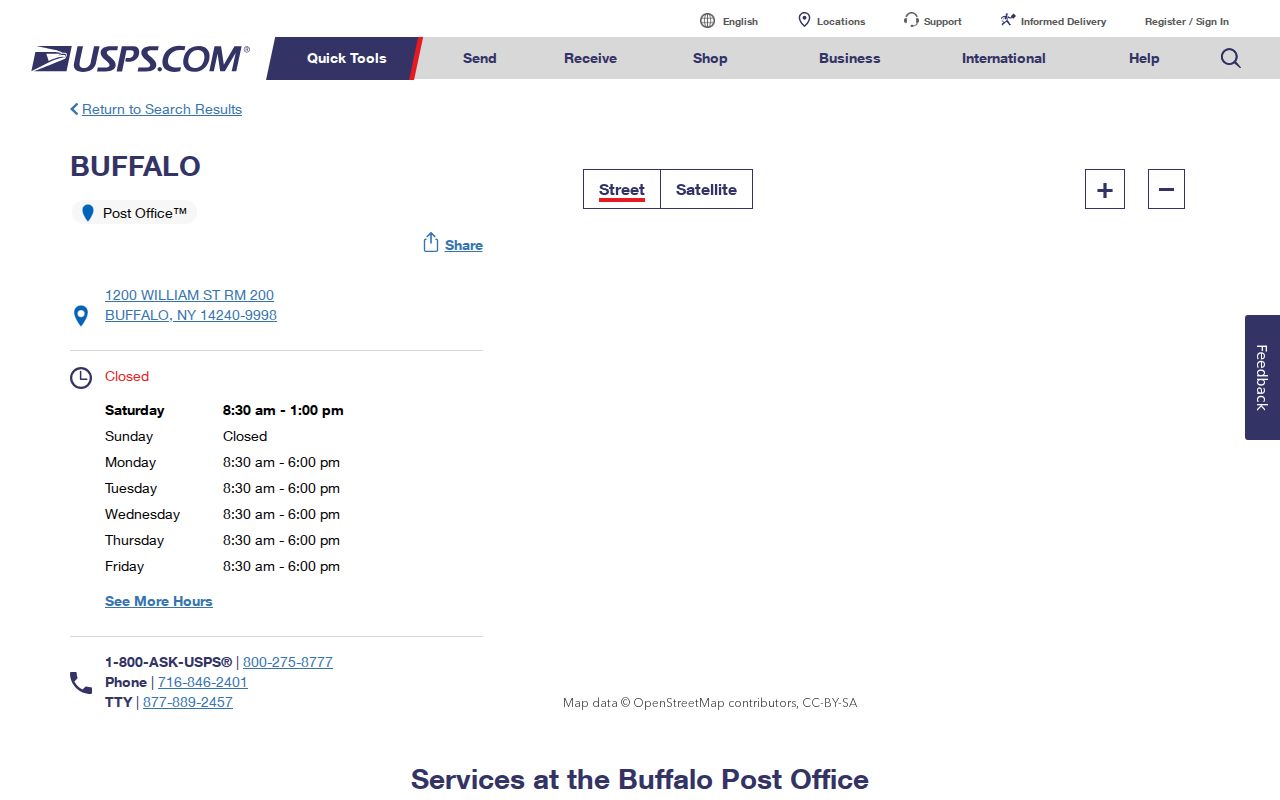
A Buffalo mailing label alone proves little. Checking the postal result beside the county parcel record keeps city jurisdiction and postal identity from getting confused.
Buffalo Historical Resident Directories
Buffalo city directories reach back to 1828. The Grosvenor Room holds a complete run from that year to the present. Digitized originals from 1832 through 1913 sit on NY Heritage. The City Records Center keeps an incomplete 1856 to 1969 run. The Buffalo History Museum holds selective Metro Buffalo reverse directories covering 1883 to 1915. Remember that a directory entry is an annual snapshot. It can place a household head, occupation, business, or address in a given year. But it proves no legal ownership and misses plenty of residents.
Early volumes tend to list names and addresses. Later ones may add occupations, wives or widows, and owner or resident marks. For an old house, the address sections are gold. Read each volume's abbreviation key. Check the years on either side. Test conclusions against census, deed, obituary, or cemetery evidence. The Buffalo city directory page walks through the full collection-by-collection method.
Buffalo Digitization Adds New Shelves
Bound city directories are only the start. The Grosvenor Room pairs them with local and family histories, vital indexes, newspapers, yearbooks, census material, church records, cemetery records, Sanborn maps, and research databases. The Buffalo History Museum adds reverse-address material, newspaper microfilm, church collections, cemetery maps, old settler deaths, and funeral ledgers. The Genealogical Society adds early-WNY vital cards. It also keeps the uneven 1865 Erie census index.
Digitization keeps widening the shelf. On July 24, 2025, the Grosvenor Room announced the Western New York Digitization Center. It is a partnership with NYG&B Digitize NY. Selected western New York organizations receive a no-cost digitization service. Records post freely through that program. That work can open future access paths. A missing digital record still calls for a catalog, shelf, or staff check. The NY Heritage Buffalo City Directories collection illustrates the digitized historical run. Its item-level metadata helps trace a Buffalo street or family year by year.
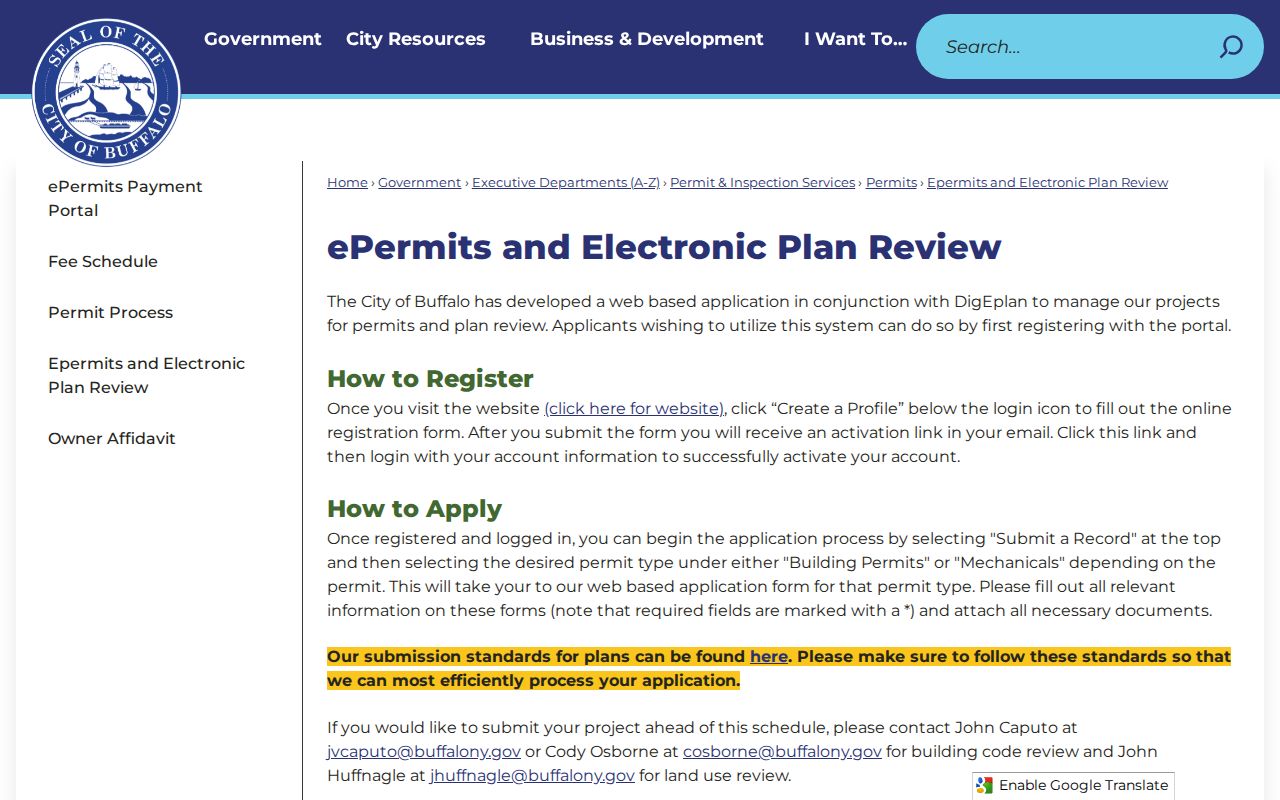
Modern address evidence can complement the historical shelf. Buffalo permits date from 2007, and the system accepts address, date-range, ZIP, and permit-type inputs.
Buffalo Records Beyond the Web
Not everything lives on the web. The Erie County Clerk offers public terminals in the basement Records area and on the first floor, with staff help for material that is not online. A mail request should identify the document type, party or owner, property address, approximate years, book or page, and return contact. Fees are modest but exact. The Clerk listed first-two-page copies at $1.30, each additional page at $0.65, and separate certified and search fees. Check the current form before paying. Fees and procedures can change.
The Grosvenor Room handles remote work differently. It limits remote requests to five directory or telephone lookups and three obituaries, normally answered in three to five days. Bulk newspaper or general microfilm searches are not promised. The History Museum and New York State Library offer in-person or microfilm alternatives. New York FOIL sets its own clock. A written request ordinarily receives a grant or denial within five business days, or an acknowledgment with an approximate date. Records governed by their own access statutes follow those procedures instead.
The free Erie Property Alert service accepts an SBL and party names, including variants such as Jr. or II. Alerts arrive only after a document is recorded. The service does not stop property fraud.
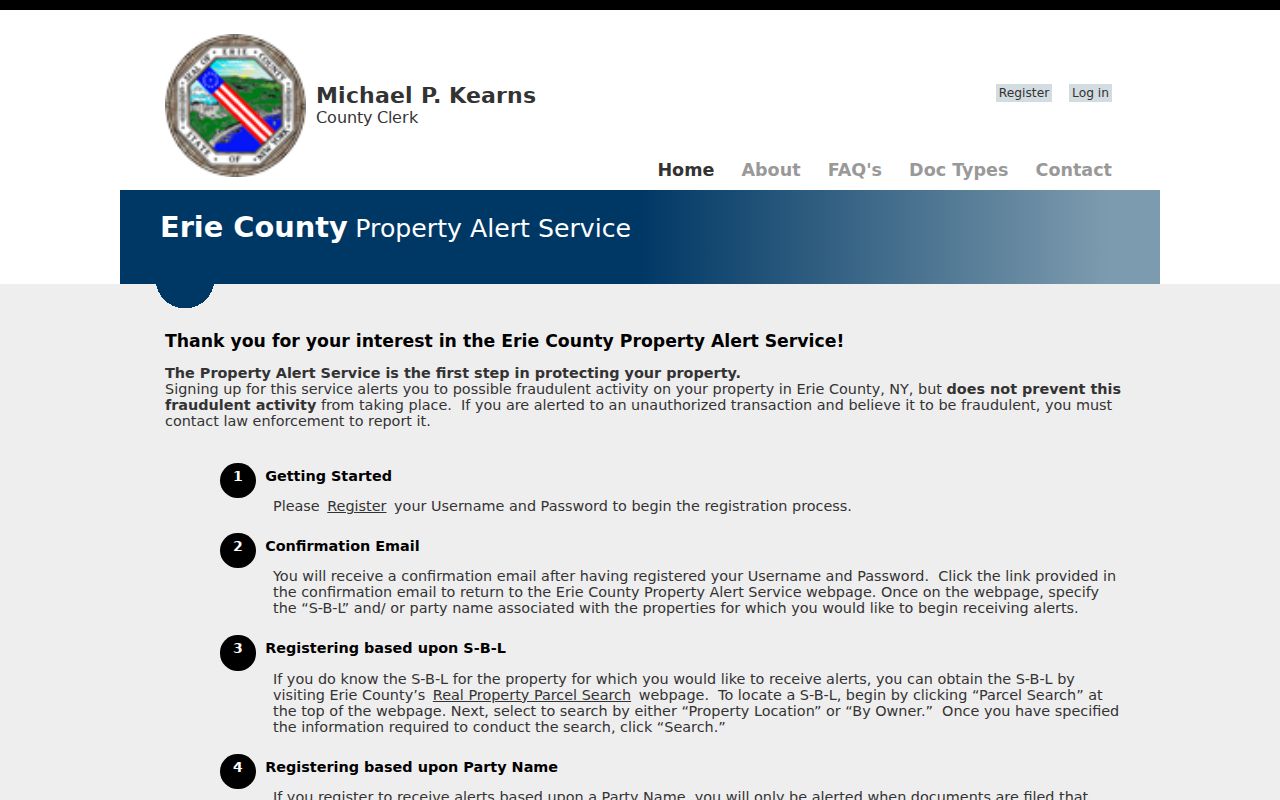
Treat alerts as a heads-up only, and confirm each message against the Clerk's own record route.
Buffalo Court and Probate Trails
Same-name residents can blur together quickly. Public court indexes help separate them. An address trail often ends with an estate or obituary. New York e-Courts opens routes for WebCivil Local, WebCivil Supreme, WebCriminal, WebFamily, eTrack, and NYSCEF. Erie County estates get their own tool. The Surrogate's Court search offers name, file, old-index, book-page, and will modes. A result can name a party, case or file number, date, and court. Not every filing or personal detail becomes public.
Older Surrogate material may need a trip downtown. Erie public computers at 92 Franklin Street can show more than the web route. Some image links cover files after February 19, 2014. Older files can require courthouse access or a request to a custodian. Sealed, expunged, juvenile, family, adoption, and confidential personal-information material stays restricted. A probate entry answers a documented heir or estate question. It is not a general people directory.
Note: Compare court and probate indexes with dated property, vital, or obituary evidence before assigning a record to a Buffalo resident.
Buffalo Resident Privacy Gaps
Some gaps in a Buffalo residents directory are deliberate. Casual DMV access is barred by the federal Driver's Privacy Protection Act. Confidential voter registration restricts its own category. So does the Address Confidentiality Program. Sealed court files, protected family matters, and current vital-record rules each restrict their own categories. Utility lists are not public resident rolls. A parcel owner can be named without identifying other adults or children at the address.
| Official or compiled source | Strength | Use with care |
|---|---|---|
| Custodian record | Defines a specific recorded fact and access rule | May be dated, partial, or restricted |
| Commercial compiled listing | Can suggest an older lead | May merge people, retain stale data, or omit the source context |
Verify important facts with the agency, library, court, or records office that created or holds the material. Records exist for answers, not harm. Never stalk or harass a person with records.