
Buffalo City Directory Collections
Buffalo has several overlapping directory shelves, so one missing bound volume does not end a search. The Buffalo & Erie County Public Library's Grosvenor Room has the complete Buffalo run from 1828 to the present. The city Records Center has an incomplete Polk run from 1856 through 1969. NY Heritage supplies original, digitized Buffalo volumes from 1832 through 1913, while the Buffalo History Museum adds a selective reverse-address resource. Each collection answers a slightly different question: a normal volume begins with names, while a reverse book begins with an address.
| Collection | Years | Where Held | Access |
|---|---|---|---|
| Buffalo directories / Polk | 1828-present | Grosvenor Room | Noncirculating local-history collection |
| Buffalo directories / Polk | 1856-1969, incomplete | Buffalo Records Center | Appointment access |
| NY Heritage Buffalo directory collection | 1832-1913 originals and digitization | NY Heritage | Free online images and metadata |
| Metro Buffalo reverse directories | 1883-1915 | Buffalo History Museum | Selective, in-person research collection |
| Buffalo city-directory microfilm and fiche | 1828; selected years through 1989 | New York State Library | Film and fiche fallback |
The New York State Library's list is useful when a local copy is missing. Its Buffalo holdings include 1828, 1832, selected nineteenth-century fiche, long microfilm sequences through the 1970s, and selected 1980s years. It also holds suburban runs, an important distinction when a postal address says Buffalo but the property is outside city limits.
Buffalo Directory Year Runs
The first known Buffalo directory year in the local run is 1828. Polk is a recurring label in later city-directory holdings, but the research path should follow the actual year and holding location rather than assume every book is identical. The Records Center's series is valuable but incomplete. Its other historical material, including assessment books and maps, can help explain a street or parcel when a directory year is absent.
- 1828: the complete Grosvenor Room Buffalo city-directory run begins.
- 1832-1913: NY Heritage's original volumes are digitized, with 77 items in the collection.
- 1856-1969: the Buffalo Records Center preserves an incomplete Polk directory run.
- 1883-1915: the History Museum's Metro Buffalo reverse directories cover selected areas.
- Present: Grosvenor's complete run continues beyond the historical digitized set.
Publication and access gaps are not proof that a household disappeared. Search the nearest years, then check the alternative shelf, film, or newspaper collection. A person may have moved, used an initial, appeared under a business, or simply not been included in that annual volume.
Note: A Buffalo annual volume records a publishing snapshot, so it should be compared with another dated source before drawing a firm conclusion.
Buffalo Directory Digitization
NY Heritage's digitized Buffalo collection provides the most direct online route into the 1832-1913 run. Its 77 digitized items include front matter as well as annual lists of residents, businesses, and institutions. That front matter can contain historical notes and the abbreviation key needed to read a page accurately.
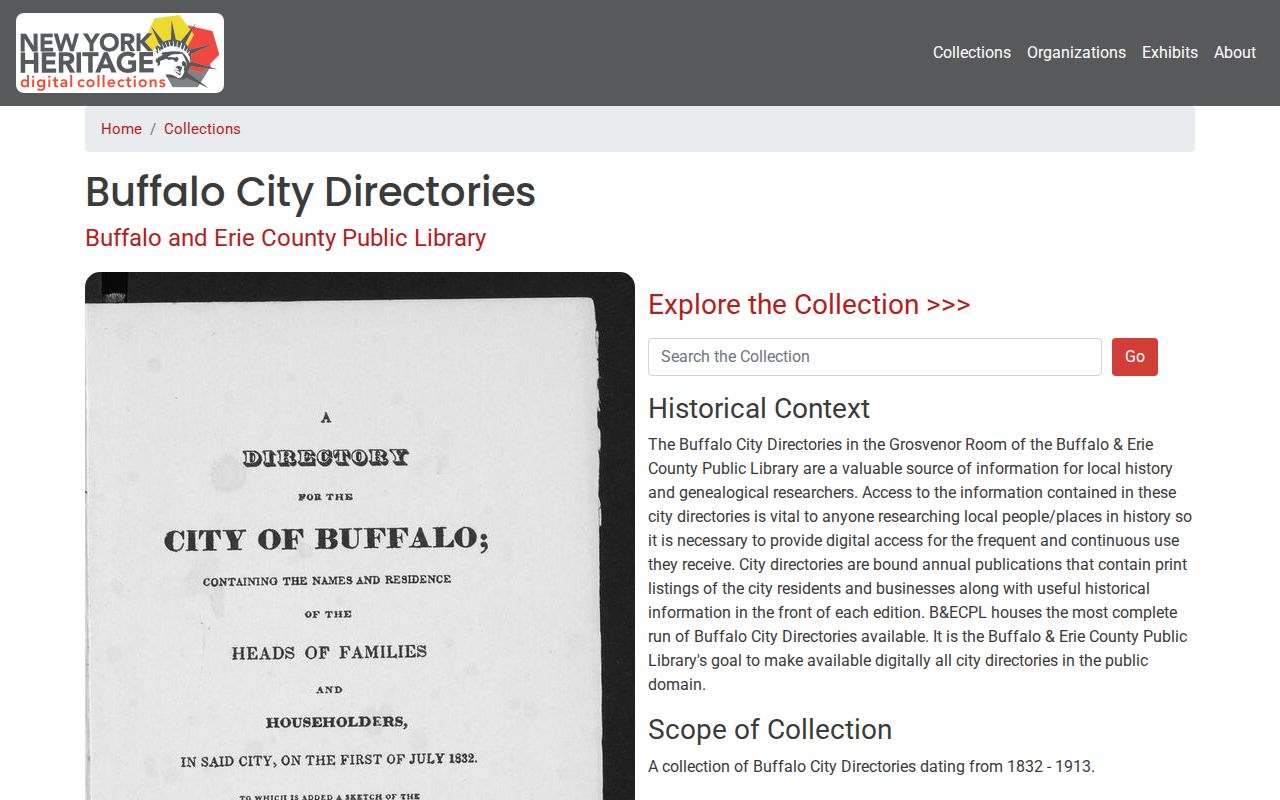
The digitized collection is especially useful for testing name variants before arranging an in-person visit. The image set does not replace the later Grosvenor volumes, the Records Center's incomplete run, or the state-library film, but it can establish an address or business trail during its coverage period.
In July 2025, the Western New York Digitization Center opened in the Grosvenor Room through an NYG&B Digitize NY partnership. Selected Western New York organizations can receive no-cost digitization service, and resulting records are posted freely through NYG&B. That effort is a practical sign that more local material may become easier to consult, even though each collection still needs its own coverage check.
Buffalo City Directory at Grosvenor
The Grosvenor Room is the central Buffalo shelf for directory work. Along with the complete directory run, it holds 30,000 noncirculating printed local, family, and military histories; census resources; vital indexes; church and cemetery material; yearbooks; Sanborn maps; and local newspapers. These companion sources are useful when a name changes, an address vanishes, or a directory entry needs family context.
Remote reference is deliberately narrow. Library staff advertise up to five city or telephone directory lookups and up to three obituaries when a full name and date are supplied. Responses generally take three to five days, and documents may be emailed when possible. The service does not take on full remote research, remote New York State vital-index searching, bulk newspaper work, or general microfilm lookups.
For an on-site search, bring the name spelling, street form, possible old street name, and a small range of years. Those details make it easier to move between a directory, a census database, a yearbook, and a newspaper reel without treating one short entry as final proof.
Reading a Buffalo City Directory Entry
A Buffalo directory entry often compresses a great deal into one line. The 1864 digitized item gives its date and subject, carries the identifier buffalocitydir_1864_170.tif, and is held by the Buffalo & Erie County Public Library. On the printed page, local entries commonly give a surname and given name, occupation or business reference, street address, and a spouse, widow, homeowner, or resident notation.
The 1864 Buffalo directory item on NY Heritage shows the catalog and image context that should travel with a transcription.
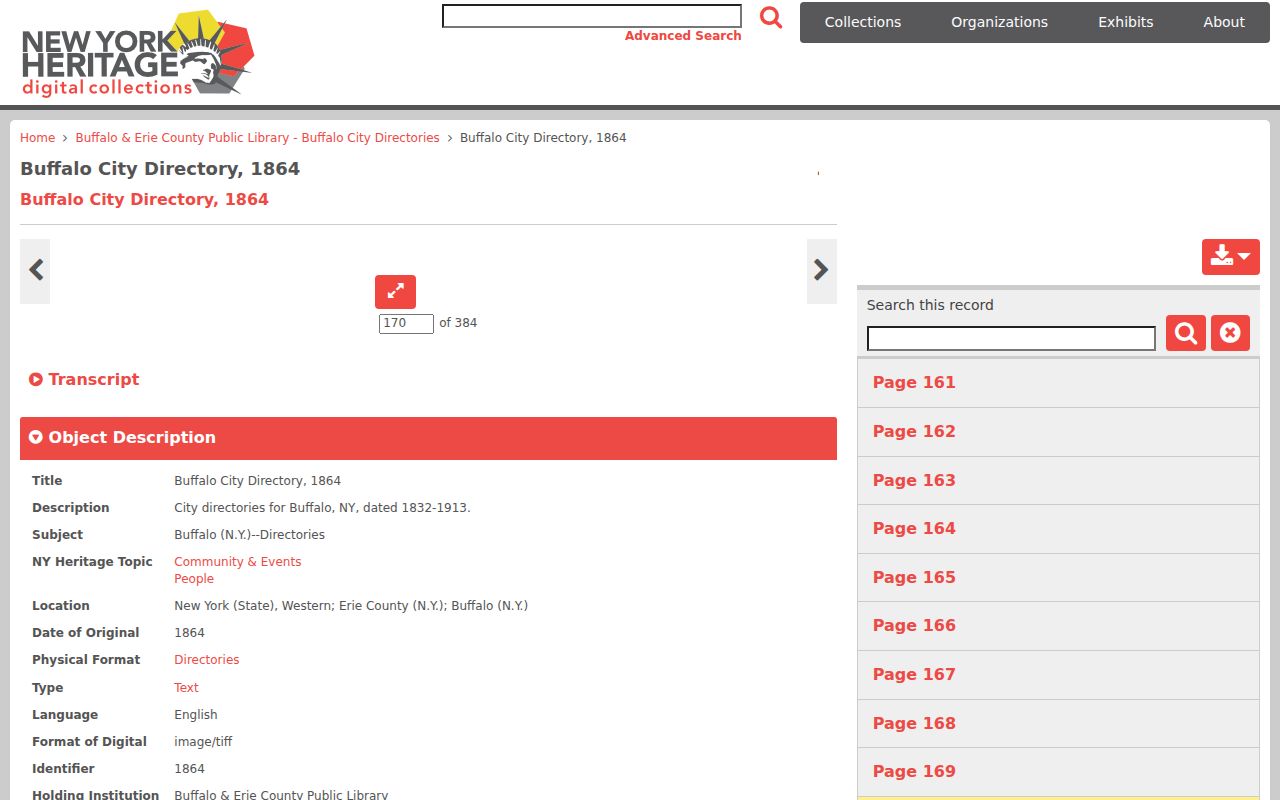
Copy the page, year, spelling, address, and every mark exactly. An entry can describe a business, boarder, widow, or household head. It is not proof of legal ownership or a complete account of every occupant, so connect it with a parcel record, deed, obituary, census, or later directory before deciding what happened.
| Name | Surname and given name, sometimes with initials or a household notation. |
|---|---|
| Occupation or business | Work or business reference that can distinguish people with the same name. |
| Address | Street number and street name, copied with its directional and suffix. |
| Household notation | Spouse or widow notation when the volume supplies it. |
| Owner or resident mark | Read the volume key before interpreting [h] or [r]. |
- Criss-cross directory
- A reverse-address arrangement that starts with a street and number, then identifies a listed occupant. Buffalo's surviving Metro Buffalo set is selective.
- Householder index
- An alphabetical name arrangement that helps locate the listed household head before checking an address section.
- Abbreviation key
- The volume's explanation of shortened terms and marks. Read it first because use can vary by year.
Buffalo Reverse Directories, 1883 to 1915
The Buffalo History Museum has Metro Buffalo reverse directories for 1883 through 1915. They can turn an address into a listed occupant, which is the opposite of a normal alphabetical volume. Their coverage is mostly West Side and middle- or upper-income areas, so a missing address or name must not be treated as evidence that nobody lived there.
The Buffalo History Museum research library describes the directory, reverse-address, newspaper, church, cemetery, and local-index holdings that can extend this work.
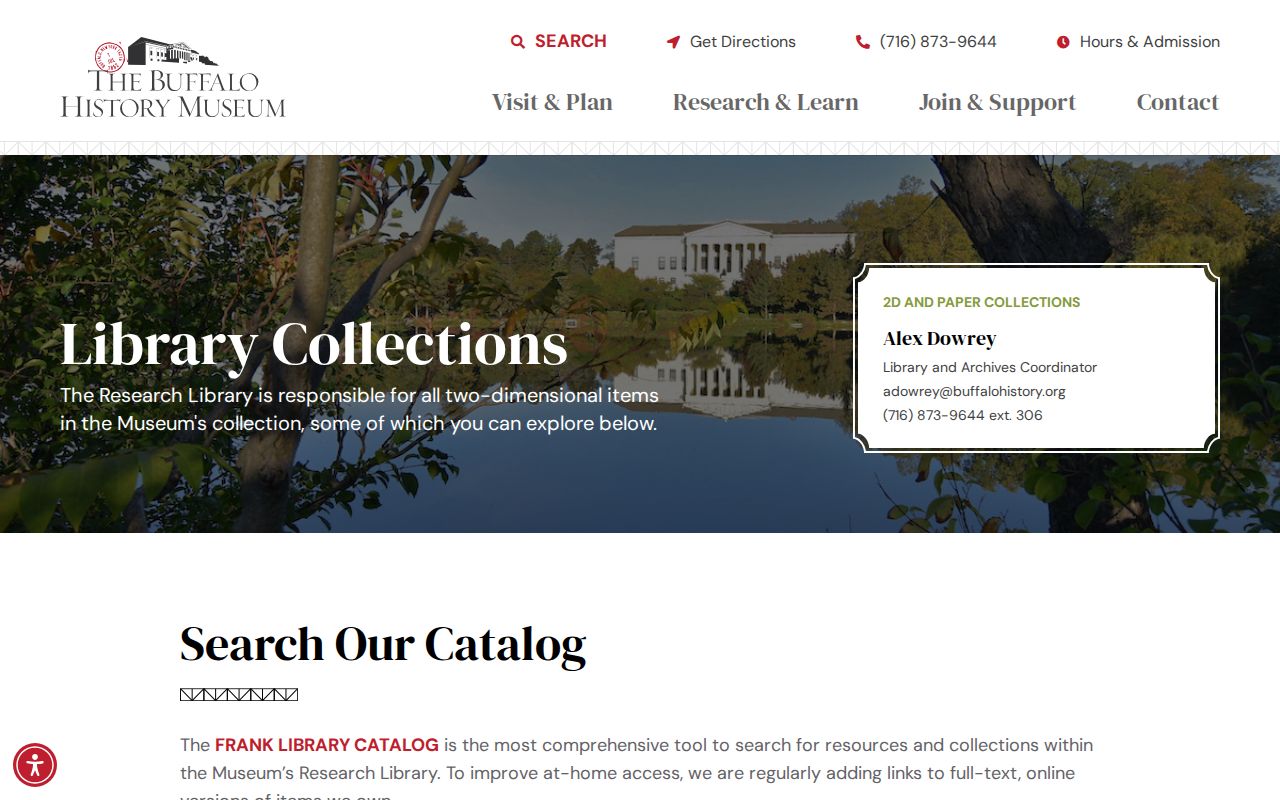
The library is at One Museum Court, Buffalo, New York 14216, and can be reached at 716-873-9644. It is open Wednesday and Saturday from 10 to 5 and Sunday from 12 to 5. Appointments are limited, and nonmember research appointments cost $15. Its church microfilm, cemetery maps, old settler death records, and funeral ledgers may help when a directory trail ends.
Pair Buffalo City Directories With Census
Use a directory for annual continuity and a federal census for household detail. The public census reaches through 1950 under the 72-year rule. A census can supply ages, relationships, and birthplaces at its decennial date; the Buffalo city-directory volumes can show whether a person or business was at the same address in the years around it.
- Search the address section first, including an old spelling, directional, street type, or number variant.
- Find the same name in the alphabetical section and transcribe the entry, its year, and the abbreviation key.
- Move one year backward and forward, checking surnames, businesses, and alternate spellings.
- Pair the relevant directory decade with the federal census year to test household composition.
- Confirm ownership through Erie parcel and deed records, then use newspapers, obituaries, probate, cemeteries, or later directories to explain a disappearance.
A blank year can reflect a move, death, marriage, name change, business listing, boundary change, or an omission in the particular book. Buffalo sources also carry Polish, German, Irish, Italian, Black migration, Eastern European, and other naming traditions, so maiden names, diacritics, initials, Anglicized forms, and suffixes deserve separate searches.
Buffalo Directory Trails Before Registration
For the earliest family work, Buffalo's vital-record timeline matters. Local birth records begin in 1878, marriages in 1877, and deaths in 1852. Earlier searches often rely on churches, cemeteries, newspapers, tax books, county material, and the directory volumes rather than a municipal vital index. The History Museum's newspaper microfilm runs from 1811 to 2012, while the Grosvenor Room has the Buffalo Evening News from 1881 and the Courier Express from 1926 through 1982.
Obituaries can bridge a last city-directory appearance to a cemetery, probate file, or surviving-family notice. For a street or property question that becomes current rather than historical, use the address-based records on the Buffalo Street Directory instead of expecting an older printed volume to identify today's occupants.
Note: A reverse directory, obituary, or census can strengthen a Buffalo city-directory lead, but each source has its own date and coverage limits.