
Finding Buffalo Residents Carefully
Buffalo does not keep one public roster of everyone who lives in the city. A property card may identify an owner, while an annual directory can show a household head at an earlier address. An Erie County deed shows parties to a conveyance, not current occupancy. The Erie Board of Elections offers records and FOIL channels, but the research found no unrestricted public name-to-address voter search. Start with the fact already known, such as a street address, a full name, an approximate year, or a family connection. Then choose a record family that can answer that specific question.
For a current property question, separate the parcel's situs, or physical location, from its tax mailing address. They can differ. For an older household, use a directory address section and then check nearby years, census, obituaries, or probate. A court index can verify a public party appearance, but a docket is not a complete biography. Buffalo resident searches work best when dates, roles, and addresses agree across two sources.
- Begin with the Buffalo assessment card or Erie parcel system when you have an address or owner name.
- Save the parcel's SBL or PIN, its situs, and its deed reference before moving to the County Clerk index.
- Use the Clerk's party, parcel, instrument, or book-and-page options for a recorded-document trail.
- For a past household, compare Buffalo city directory years with census, newspaper, and vital-index evidence.
- When a digital index stops, use the counter, public terminal, library, mail request, FOIL route, or state archive named by the custodian.
Note: A public record can establish a narrow fact, so match the record type to the question before drawing a conclusion.
Buffalo Resident Records Desks
Several custodians make up the Buffalo residents directory trail. The City assessment system and county parcel tools handle property context. The Erie County Clerk keeps recorded land documents and older county record groups. The City Clerk is the local registrar for Buffalo events, while the New York State Department of Health is the statewide route for records outside New York City. The Board of Elections handles election records subject to its access rules. The library and historical repositories preserve the shelves that make older Buffalo searches possible.
Erie County Clerk
92 Franklin Street
Buffalo, NY 14202
Records counter and public terminals
Buffalo Assessment and Taxation
City of Buffalo property records
Buffalo, NY
Assessment/address guidance: 716-851-5771
Erie County Board of Elections
134 West Eagle Street
Buffalo, NY 14202
716-858-8891
The detailed address-to-parcel path uses the Buffalo street-directory method. Here, the useful distinction is custody: an office can often confirm one kind of fact while another office holds the next link in the chain.
Buffalo Property Card Clues
The City of Buffalo property record card is a practical opening record for an address or owner name. Its sections can show key information, land and site size, residential building details, improvements, exemptions, sale and transfer history, tax detail, and an aerial link. A result can also distinguish the physical parcel address from a mailing or tax address. That distinction matters when an owner is a trust, an estate, a business, or lives elsewhere.
| Property-card field | How it helps a Buffalo search | Important limit |
|---|---|---|
| Street address or owner | Finds the current property record | Spelling variants may be needed |
| Situs and mailing address | Separates parcel location from owner correspondence | Mailing address does not establish occupancy |
| Sale transfer history | Supplies a bridge to the deed trail | Check the Clerk record for document detail |
| Tax detail and aerial links | Add parcel context | They are not a household list |
The City's property-card orientation shows the labeled sections used before a Clerk search. The result is best treated as an owner-and-parcel record rather than a list of all people at a Buffalo address.
Buffalo Parcels Lead to Deeds
Erie County's official-records index does not perform an ordinary street-address search. That local detail changes the workflow. Use the City property card, Erie PayTax, or the GIS viewer to obtain the parcel, SBL, current owner, and deed book and page or file number. Then search the Erie Clerk Browser View by party, document type, instrument number, book and page, map number, parcel ID, or date range. A parcel is the unit of land in the tax and mapping system. A deed is the recorded document that names a grantor, the party conveying an interest, and a grantee, the party receiving it.
Erie maintains deeds from 1808. The online deed index starts January 1, 1986, and deed images begin January 1, 1960. Older work may require an alphabetical grantor-grantee index, Liber or book and page, microfilm, books, a public terminal, or a request to the Clerk. Search metadata can be public even where image access depends on the available account, browser route, or counter access. Names should be tried with spelling variants, especially when a party is an estate, trust, or corporation.
The Erie Clerk Browser View appears below with its party, parcel, map, instrument, and book-page modes. Those choices explain why the parcel identifier is the useful handoff from an address search.
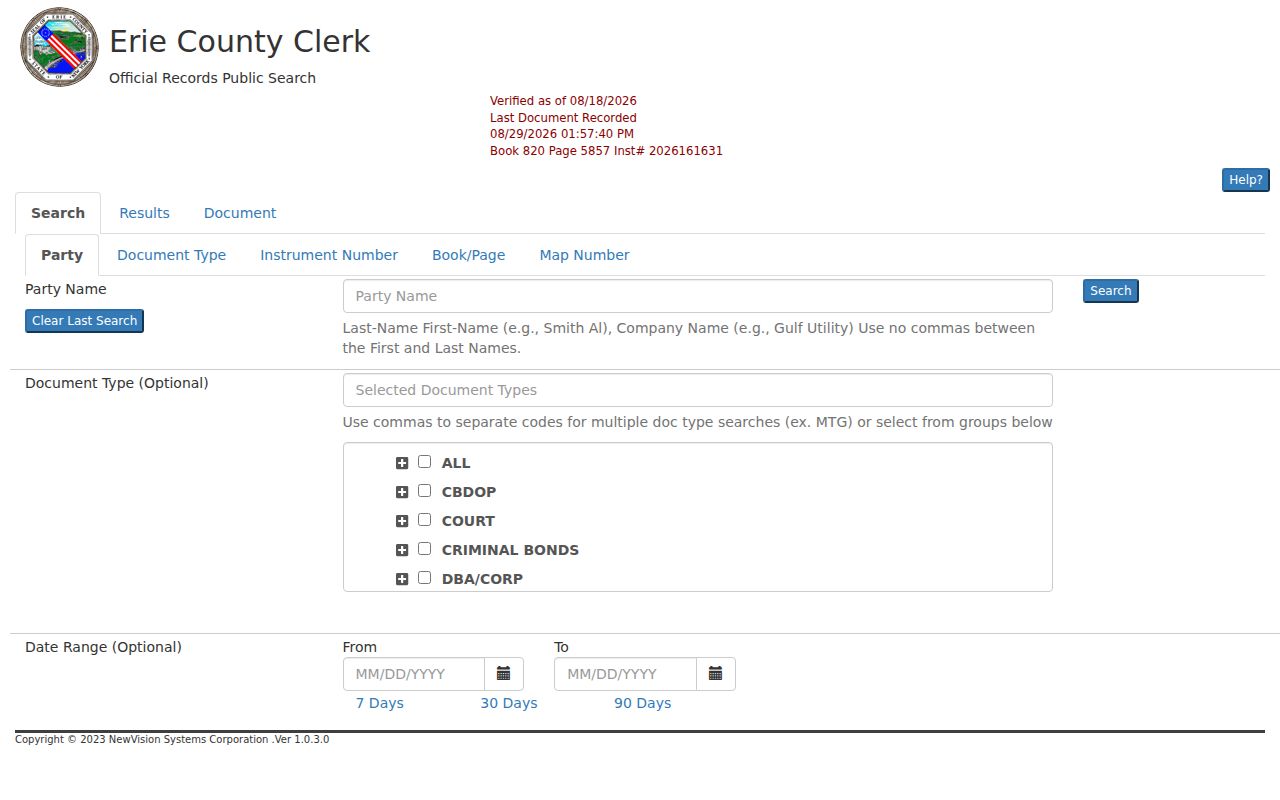
Use the returned document role and recording date to build a dated ownership trail, then verify any older gap with the Clerk's offline channels.
- Parcel or SBL
- A tax and mapping identifier used to join a property to county records.
- Index
- A finding tool that points to a record, not necessarily the full record image.
- Criss-cross directory
- An address-first directory that can identify selected historical occupants.
- Recorded party
- A person or entity named in a filed document, whose role is not automatically current residence.
Buffalo Voter Records Have Limits
Election material is not an open Buffalo residents directory. The county information page points to registration, apportionment, and FOIL routes. A voter-file request uses an elections-purpose statement under Election Law §3-103(5), and the county form supports geography, party, selected fields, and address or name sorting. Protected voter registrations are withheld. The online state registration route lets a voter register or update information; it is not a public resident-search tool.
New York's confidential registration process under Election Law §5-508 and the Address Confidentiality Program under Executive Law §108 intentionally create gaps. An absent name can reflect a protected status, list maintenance, a different jurisdiction, or a record type that does not apply. For current personal research, use a property, court, business, license, or historical record that fits the question rather than assuming an election file will answer it.
Current Buffalo Resident Sources
Current sources each describe a different relationship. Property records are strongest for the owner-parcel connection. Deed records show parties to transfers and other filings. Court indexes can place a name in a public case, subject to strong privacy restrictions. Business and professional-license records can verify a public filing or credential, but they do not establish where someone lives. A vital index points to an event, while a current certified copy has eligibility rules.
| Buffalo source | What it can show | Custodian | Access path |
|---|---|---|---|
| Property card and parcel record | Owner, situs, mailing address, parcel details | City and Erie County | Public search |
| Recorded-document index | Grantor, grantee, document date, legal parcel clues | Erie County Clerk | Index, terminal, counter, or request |
| Election record | Requested registration fields where law permits | Erie Board of Elections | FOIL with election-purpose limits |
| Court or probate index | Public case or estate metadata | New York courts | e-Courts, clerk, or public terminal |
| Business and license search | Public filing or credential data | New York Department of State | Official state search |
One-person verification needs a different sequence of cross-checks. The Buffalo resident lookup page keeps that name-first workflow separate from the property and historical routes.
Buffalo Genealogy Time Windows
Buffalo's local vital trail has precise thresholds. Buffalo birth material begins in 1878, marriage material in 1877, and death material in 1852. For genealogy, New York guidance generally opens births after 75 years when the subject is known deceased, deaths after 50 years, and marriages after 50 years when both parties are deceased. Current certified copies use a separate eligibility process. Buffalo's City Clerk is the local registrar for Buffalo events; the State Department of Health is the statewide source for events outside New York City.
A Buffalo genealogy request asks for the name, date and place, record type, requester information, and a self-addressed envelope. The researched local route is a $22 request that includes a three-year search and copy or no-record response. The state route also uses a $22 three-year genealogy search but cautions that processing can take eight months or more. For pre-1914 Buffalo birth and marriage research, use the City Clerk, Erie, library, or historical-index paths rather than assuming the ordinary statewide series applies.
The Buffalo genealogy-records route documents the local windows, request details, and mailing path.
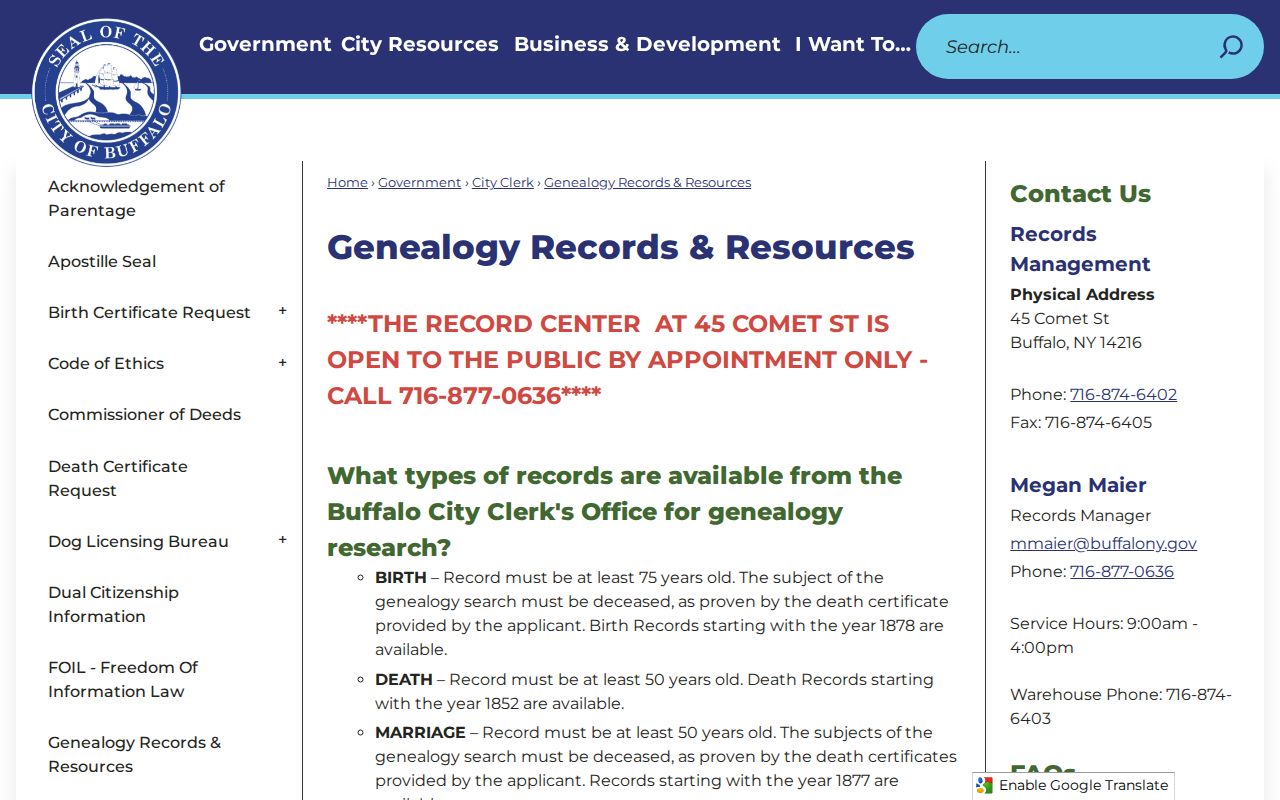
For earlier families, pair an index result with directory, church, cemetery, newspaper, or county evidence before requesting a record.
Note: Vital access is not an ordinary FOIL request, so use the current registrar application and eligibility instructions.
Buffalo ZIPs Need a Jurisdiction Check
A Buffalo postal label is not always a City of Buffalo parcel. Nearby Kenmore, Amherst, Cheektowaga, Lackawanna, and West Seneca addresses can share Buffalo postal identity. Confirm the municipality, parcel, and ZIP together before selecting a tax or assessment custodian. USPS controls delivery ZIP and post-office naming, while the Erie GIS ZIP layer is Census geography and not a city boundary.
The Buffalo Post Office listing supplies an official postal contact route. It should be used to confirm a current delivery address, while the parcel system resolves the property jurisdiction. ZIP questions by neighborhood and postal code are handled in more detail on the ZIP directory page.
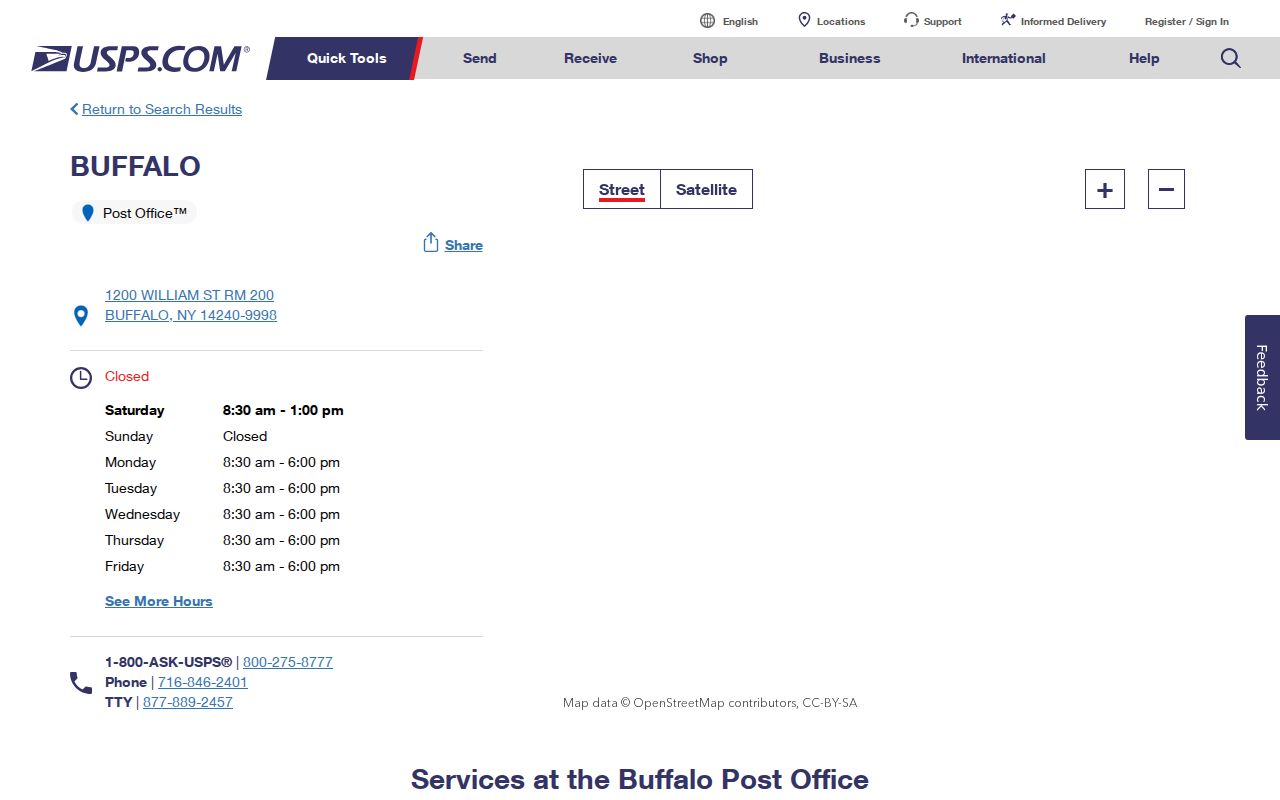
Checking the postal result beside the county parcel record prevents a Buffalo mailing label from being treated as proof of city jurisdiction.
Buffalo Historical Resident Directories
Buffalo city directories begin in 1828, and the Grosvenor Room holds a complete run from 1828 to the present. NY Heritage provides digitized originals from 1832 through 1913. The City Records Center has an incomplete 1856 to 1969 run, while the Buffalo History Museum holds selective Metro Buffalo reverse directories for 1883 to 1915. A directory entry is an annual snapshot. It can place a household head, occupation, business, or address in a year, but it does not prove legal ownership or capture every resident.
Early entries often list names and addresses; later volumes may add occupations, wives or widows, and owner or resident marks. Address sections are especially useful for an old house. Read each volume's abbreviation key, check years on either side, and use census, deed, obituary, or cemetery evidence to test a conclusion. The Buffalo city directory page has the full collection-by-collection method.
Buffalo Digitization Adds New Shelves
The library route is not limited to bound city directories. The Grosvenor Room combines directories with local and family histories, vital indexes, newspapers, yearbooks, census, church and cemetery material, Sanborn maps, and research databases. Buffalo History Museum adds reverse-address material, newspaper microfilm, church collections, cemetery maps, old settler deaths, and funeral ledgers. The Western New York Genealogical Society provides additional early-WNY vital cards and the uneven 1865 Erie census index.
On July 24, 2025, the Grosvenor Room announced the Western New York Digitization Center, a partnership with NYG&B Digitize NY. It offers selected western New York organizations a no-cost digitization service and posts records freely through that program. That work can create future access paths, but a missing digital record still calls for a catalog, shelf, or staff check.
The NY Heritage Buffalo City Directories collection illustrates the digitized historical run and its item-level metadata.
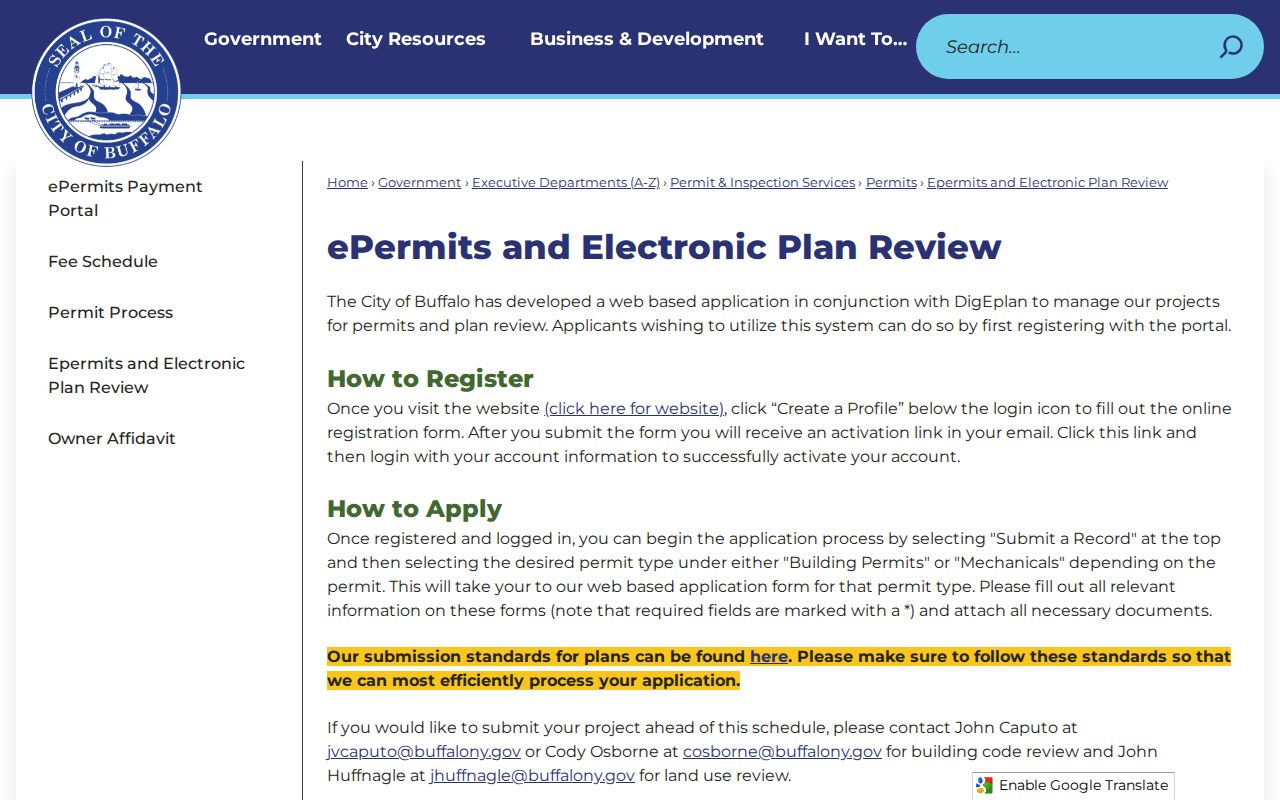
Modern address evidence can complement the historical shelf: Buffalo permits begin in 2007, and the system accepts address, date-range, ZIP, and permit-type inputs.
Buffalo Records Beyond the Web
Digital access has dates and channels. The Clerk offers public terminals in the basement Records area and first floor, with staff help for material that is not online. A mail request can identify the document type, party or owner, property address, approximate years, book or page, and return contact. The Clerk's research described first-two-page copies at $1.30 and each additional page at $0.65, with separate certified and search fees. Check the current form before paying because fees and procedures can change.
For local history, the Grosvenor Room offers remote work limited to up to five directory or telephone lookups and up to three obituaries, normally in three to five days. It does not promise bulk newspaper or general microfilm searches. The History Museum and New York State Library add in-person or microfilm alternatives. Under New York FOIL, a written request ordinarily receives a grant or denial within five business days, or an acknowledgment with an approximate date, but records governed by their own access statutes follow those procedures instead.
The free Erie Property Alert service accepts an SBL and/or party names, including name variants such as Jr. or II. It alerts after a document is recorded; it does not stop property fraud.
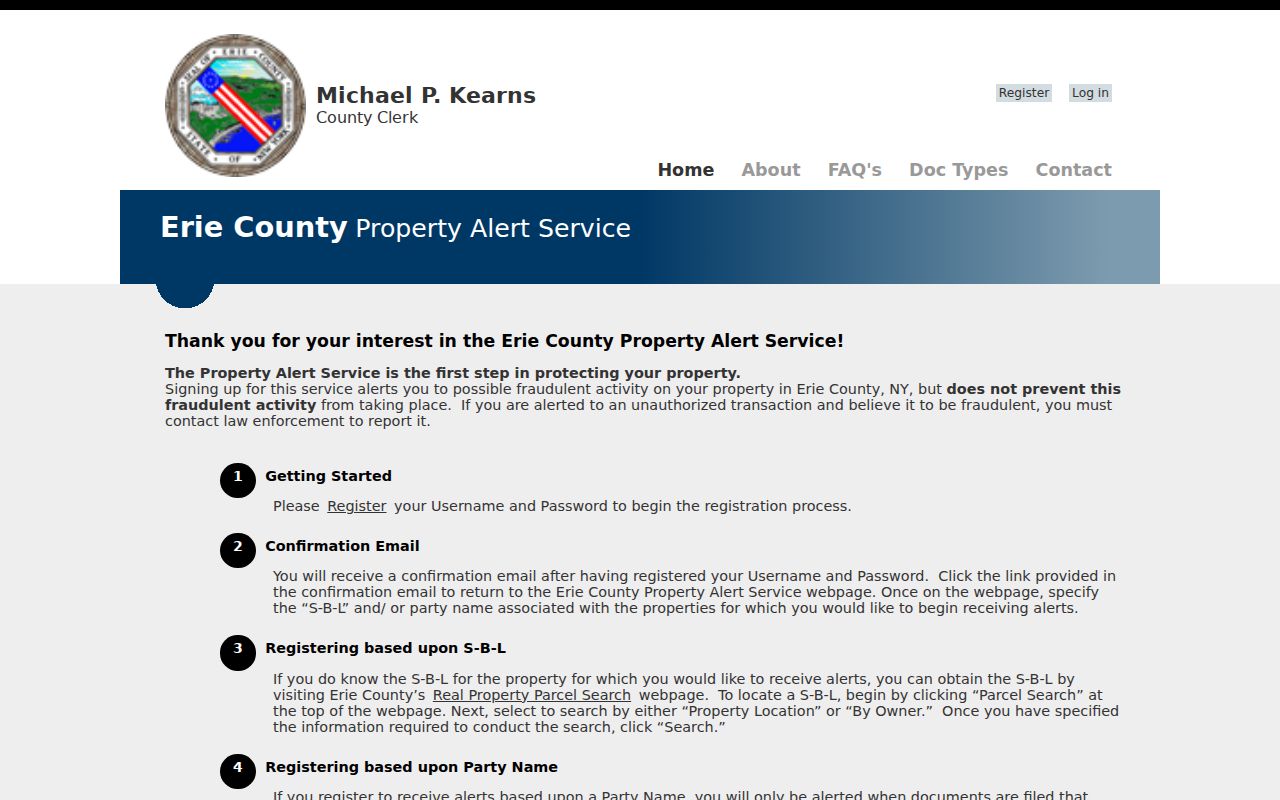
Use an alert as a notice tool and independently verify every message through the Clerk's official record route.
Buffalo Court and Probate Trails
Public court indexes can help distinguish people with the same name, especially when an address trail ends with an estate or obituary. New York e-Courts opens routes for WebCivil Local, WebCivil Supreme, WebCriminal, WebFamily, eTrack, and NYSCEF. For Erie County estates, the Surrogate's Court search offers name, file, old-index, book-page, and will modes. A court result can identify a party, case or file number, date, and court context. It does not make every filing or personal detail public.
For older Surrogate material, Erie public computers at 92 Franklin Street may show more than the web route. Some image links are available for files after February 19, 2014, while older files can require courthouse access or a custodian request. Sealed, expunged, juvenile, family, adoption, and confidential personal-information material remains restricted. A probate entry is useful for a documented heir or estate question, but it is not a general people directory.
Note: Court and probate indexes should be compared with dated property, vital, or obituary evidence before assigning a record to a Buffalo resident.
Buffalo Resident Privacy Gaps
Some gaps in a Buffalo residents directory are deliberate. The federal Driver's Privacy Protection Act restricts casual access to DMV personal information. Confidential voter registration, the Address Confidentiality Program, sealed court files, protected family matters, and current vital-record rules restrict access to different categories. Utility and delivery lists are not public resident rolls. A parcel owner can be named without identifying other adults or children at the address.
| Official or compiled source | Strength | Use with care |
|---|---|---|
| Custodian record | Defines a specific recorded fact and access rule | May be dated, partial, or restricted |
| Commercial compiled listing | Can suggest an older lead | May merge people, retain stale data, or omit the source context |
When a fact matters, verify it with the agency, library, court, or records office that created or holds the material. Never use a record trail to stalk, harass, or harm a person.